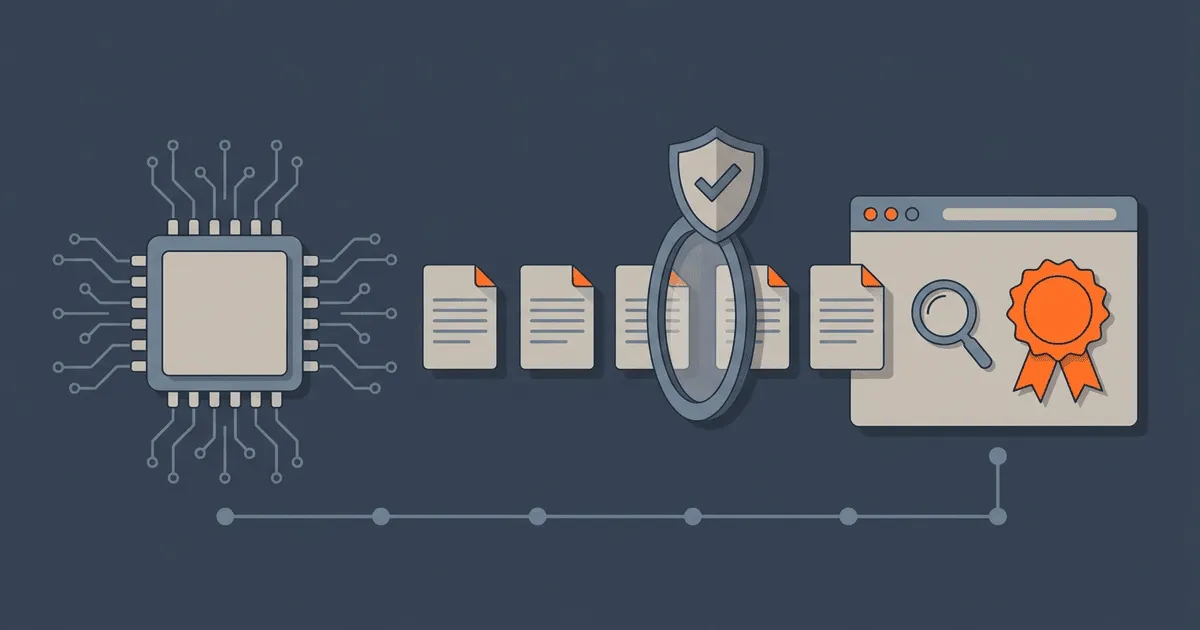
AI creates target text quickly, while terminology, context, and approval decisions remain hard to review. Fast generation creates a massive review queue, but many automated systems do not preserve why text changed or who accepted it. To fix this, teams must separate automatic integrity checks from linguistic approval, record model and prompt provenance, and keep reversible reviewer decisions.
The problem with unchecked AI translation
In traditional localization, human translators provide natural pauses in the workflow. They ask questions about context, verify terminology against glossaries, and naturally self-regulate the speed of output. When teams introduce AI translation, that speed constraint vanishes. Machine translation models can process thousands of strings in minutes. However, the resulting text often lacks the nuanced understanding of a human linguist, and the sheer volume of output overwhelms existing quality assurance (QA) processes.
When a human reviewer faces thousands of AI-translated strings, the cognitive load becomes unsustainable. A reviewer might spot obvious grammar errors but miss subtle shifts in tone or context. More importantly, when an error makes it to production, tracking down the root cause is exceptionally difficult. Did the AI misinterpret the source string? Was the original prompt flawed? Did a reviewer hastily approve the batch? Without a structured, auditable review workflow, these questions remain unanswered, and the same errors are likely to recur.
The core failure mode is treating AI translation as a drop-in replacement for human translation without redesigning the surrounding workflow. AI operates differently. It is highly confident, statistically driven, and prone to hallucinations. Therefore, the review process must be adapted to handle high-volume, potentially inconsistent output while maintaining strict accountability and traceability.
According to community discussions on translation workflow pain, the distinction between translation quality and structural integrity is critical. A string can be grammatically flawless but structurally broken if it drops a required variable or mangles a placeholder. These issues must be caught before a human even looks at the text.
Separating structural integrity from linguistic quality
The first step in building a robust AI translation review workflow is separating structural integrity checks from linguistic quality approval. These two concerns require fundamentally different approaches.
Defining structural integrity
Structural integrity refers to the technical correctness of a translated string. It ensures that the string can be safely rendered by the application without causing crashes or displaying broken code to the user. Key aspects of structural integrity include:
- Placeholder Preservation: If the source string contains variables like
{username}or%d, the translated string must contain exactly the same variables, unmodified. - Pluralization Logic: Languages handle plurals differently. The translated string must adhere to the correct plural rules for the target locale, often utilizing structures like the Unicode ICU MessageFormat.
- Key Mapping: The translated string must correctly map back to the original source key.
- Formatting Tags: HTML tags or specific formatting markers (e.g.,
<b>,
The i18n-validate project documents deterministic checks for missing keys, placeholders, plural structure, and malformed files. These checks should be entirely automated. A human reviewer should never have to manually verify if a {count} variable is missing; a script should flag it instantly.
Defining linguistic quality
Linguistic quality is subjective and requires human judgment. It encompasses:
- Accuracy: Does the translation accurately convey the meaning of the source text?
- Tone and Style: Does the translation match the brand's voice? Is it appropriately formal or informal for the target audience?
- Context: Does the translation make sense in the specific context of the user interface? A "Save" button requires a different translation than a "Save" discount banner.
- Terminology: Does the translation use the approved glossary terms consistently?
By automating structural checks, you free human reviewers to focus exclusively on linguistic quality. This reduces reviewer fatigue and significantly improves the overall quality of the localized product.
Implementing an auditable review architecture
An auditable workflow requires a clear, unambiguous record of how a translation was generated and who approved it. This traceability is essential for diagnosing errors and continuously improving the translation process.
Recording provenance
Whenever an AI model generates a translation, the system must record metadata about the generation process. This provenance data should include:
- Model Version: Which specific AI model and version generated the text? (e.g.,
gpt-4-turbo-2024-04-09). - Prompt Hash: A cryptographic hash of the exact prompt used to instruct the model. This allows you to trace a bad translation back to a flawed instruction.
- Generation Timestamp: Exactly when was the translation generated?
- Source String Version: Which version of the source string was used? If the source changes, the translation must be flagged for re-review.
The OASIS XLIFF 2.1 specification defines a structured localization interchange format that natively supports storing state and provenance metadata. Utilizing a standard like XLIFF ensures that provenance data is preserved even when moving translations between different tools or vendors.
Enforcing reversible decisions
Human review must be explicit and reversible. When a reviewer approves a translation, that action must be logged with their identity and a timestamp. Furthermore, the system must support versioning. If a reviewer introduces an error, it should be simple to revert to the previous known-good version, whether that was a human translation or an AI-generated baseline.
The staged review process
A robust architecture typically involves three distinct stages:
- Generation and Automated Validation: The AI generates translations. Immediately, automated scripts (like those from i18n-validate) check for structural integrity. Any string failing these checks is flagged as an error and never proceeds to human review. The AI can optionally be prompted to self-correct the structural error.
- Human Linguistic Review: Reviewers examine the structurally sound translations. They are provided with the source string, context (e.g., screenshots or UI location), and the provenance metadata. They either approve the string, modify it, or reject it with a comment.
- Final Quality Gate: Before merging translations into the main branch or deploying to production, a final automated check ensures all required strings are translated and approved.
Detailed architectural considerations for AI translation pipelines
When scaling an AI translation review workflow, the underlying architecture must support high throughput while maintaining strict data consistency. A typical pipeline begins with an extraction phase, where new or modified source strings are pulled from the codebase. These strings must be batched intelligently before being sent to the AI model. Sending strings individually incurs significant API overhead and loses the broader context that can improve translation quality.
Batching strategies should group strings by context, such as by screen, component, or feature. Providing the AI model with a batch of related strings, along with a descriptive context prompt for the entire batch, yields significantly better results than translating isolated keys. The provenance metadata must record not just the prompt, but also the specific batch grouping utilized during generation.
Integrating with version control systems
The translation workflow should be deeply integrated with your version control system (VCS), such as Git. Translations should not exist in an isolated silo; they should be treated as code. When the AI generates a new batch of translations, these should be committed to a dedicated branch (e.g., l10n/update-fr). The automated structural validation checks should run as CI/CD checks on this branch.
Human reviewers then operate on this branch, making their corrections and approvals. The final approval process should align with standard code review practices. A pull request is created, and the branch cannot be merged into the main line until the designated linguistic owner approves the changes. This leverages existing VCS access controls and audit logs to supplement the workflow's own provenance tracking.
Managing translation memory and AI models
A critical aspect of an auditable workflow is the management of Translation Memory (TM). A TM is a database of previously approved source-target string pairs. In a traditional workflow, the TM is the primary source of truth. When integrating AI, the relationship becomes more complex.
The AI model should ideally be fine-tuned or prompted using the existing TM to ensure consistency in terminology and style. However, the system must clearly distinguish between a translation retrieved directly from the TM (a 100% match) and a translation generated by the AI (even if the AI was heavily influenced by the TM).
If an AI-generated translation is modified by a human reviewer and subsequently approved, that final version should be written back to the TM. This creates a continuous improvement cycle. However, the TM entry itself must retain the provenance metadata, indicating that it originated from an AI model and was modified by a specific reviewer. This prevents polluted data from silently degrading future translations.
Addressing security and data privacy
When utilizing external AI models for translation, security and data privacy must be paramount. Source strings may inadvertently contain sensitive information, internal codenames, or unreleased feature details.
Data sanitization strategies
Before any string is transmitted to an external AI translation API, it must pass through a sanitization layer. This layer should utilize regular expressions or named entity recognition to identify and mask potentially sensitive data. For example, if a source string contains an email address placeholder, that placeholder must be preserved structurally, but the system must ensure no actual customer data is ever sent to the model.
Furthermore, teams must carefully evaluate the data retention policies of their chosen AI provider. Models that retain submitted data for future training purposes should generally be avoided for proprietary localization workflows. Enterprise agreements that guarantee data isolation and immediate deletion after processing are necessary to maintain compliance with privacy regulations.
Auditing access and API usage
The provenance data should also track which specific API key or service account was utilized to generate the translation. This allows security teams to audit API usage and identify any unauthorized access or anomalous volume spikes. The ability to definitively trace every translated string back to a specific, authorized API request is a cornerstone of a truly auditable workflow.
Handling translation failures
Even with a strong workflow, failures will occur. The system must be designed to handle these failures gracefully.
Identifying patterns in failures
When a human reviewer repeatedly corrects similar errors, this is a signal that the upstream process needs adjustment. Perhaps the glossary is incomplete, or the prompt given to the AI lacks crucial context. By analyzing the delta between the AI-generated baseline and the final human-approved version, teams can identify specific weaknesses in the AI's performance.
Updating prompts and glossaries
The review workflow should include a feedback loop. When a reviewer corrects a terminology error, that correction should ideally feed back into the system to update the glossary automatically, or at least trigger a notification to the localization manager. Similarly, if the AI consistently adopts the wrong tone, the generation prompt must be updated and versioned.
Rollback mechanisms
If a batch of poor translations accidentally reaches production, the team must be able to roll it back quickly. Because every translation state change is logged and versioned, a rollback is simply a matter of restoring the previous version of the resource file and redeploying. This is far less stressful than frantically attempting to fix translations in live production code.
Verifying the workflow
To ensure the AI translation review workflow functions correctly, you must verify it through simulated failure scenarios.
Injecting structural errors
Regularly inject known structural errors into the source strings (e.g., removing a required placeholder) and verify that the automated validation layer catches them before they reach the human review stage. If a broken string slips through, the validation scripts must be tightened.
Auditing provenance data
Periodically audit the metadata associated with deployed translations. Verify that you can trace a specific string back to the exact AI model and prompt that generated it, and identify the human reviewer who approved it. If this data is missing or corrupted, the auditability of the workflow is compromised.
Evaluating the cost of auditable workflows
While the benefits of an auditable AI translation review workflow are substantial, teams must also consider the associated costs. These costs extend beyond the direct API usage fees charged by the AI translation provider. They encompass the infrastructure required to store and index provenance metadata, the development time to integrate automated validation checks, and the training necessary to transition reviewers to the new system.
Infrastructure and storage costs
Storing detailed provenance metadata for every translation iteration requires robust database infrastructure. For a large application supporting dozens of languages, the volume of data can grow rapidly. Every generation attempt, every automated validation result, and every human reviewer action must be persistently logged. Teams should evaluate scalable storage solutions and implement data lifecycle management policies to archive older, less frequently accessed provenance data while keeping recent data readily available for immediate auditing.
Development and maintenance overhead
Integrating tools like i18n-validate and building the connective tissue between the AI translation API, the version control system, and the human review interface requires dedicated engineering resources. Furthermore, this infrastructure requires ongoing maintenance. As the application evolves and new localization requirements emerge, the validation scripts and metadata schemas must be updated accordingly. Teams must allocate sufficient engineering bandwidth to maintain the health and reliability of the localization pipeline, treating it as a critical piece of product infrastructure rather than a secondary support tool.
The future of AI in localization
As AI translation models continue to improve, the role of the human reviewer will inevitably shift. The focus will move away from correcting basic grammatical errors and towards more strategic tasks, such as ensuring brand consistency, adapting cultural nuances, and verifying terminology in highly specialized domains.
The shift towards contextual review
Future auditable workflows will likely place an even greater emphasis on providing rich context to the AI model during generation. By supplying the model with screenshots, component hierarchies, and detailed user personas, teams can significantly improve the initial quality of the translation, further reducing the burden on human reviewers. The provenance metadata will need to expand to capture not just the text prompt, but the entire contextual payload provided to the model.
Advanced quality estimation
We can also expect to see the integration of advanced Quality Estimation (QE) models into the automated validation layer. These models attempt to predict the quality of a machine translation without relying on a human reference. By incorporating QE scores into the review workflow, teams can intelligently route translations based on their predicted quality. High-confidence translations might bypass human review entirely for certain low-risk content types, while low-confidence translations are automatically flagged for intensive review. This dynamic routing will require careful calibration and continuous monitoring to ensure that quality standards are maintained.
Ultimately, the goal of an auditable AI translation review workflow is not simply to process translations faster, but to build a transparent, accountable, and continuously improving system that empowers both machines and humans to do their best work. By separating structural integrity from linguistic quality, recording comprehensive provenance data, and enforcing reversible decisions, teams can harness the speed of AI without sacrificing the reliability and quality required for a global product.
Next steps for implementation
To implement this workflow, begin by isolating your structural validation. Adopt a tool like i18n-validate and integrate it into your continuous integration (CI) pipeline. Ensure that any commit containing broken translation structures fails the build automatically.
Once structural integrity is enforced mechanically, redesign your review interface. Ensure that reviewers see the provenance data alongside the translation. Require explicit approval actions and log every decision. Finally, establish a regular cadence for reviewing the modifications made by human reviewers to identify patterns and refine your AI prompts and glossaries.
References
- GitHub: i18n-validate - Documents deterministic checks for missing keys, placeholders, plural structure, and malformed files.
- Reddit: Localization workflow pain - Distinguishes translation quality from structural integrity.
- OASIS: XLIFF 2.1 - Defines a structured localization interchange format that natively supports storing state and provenance metadata.