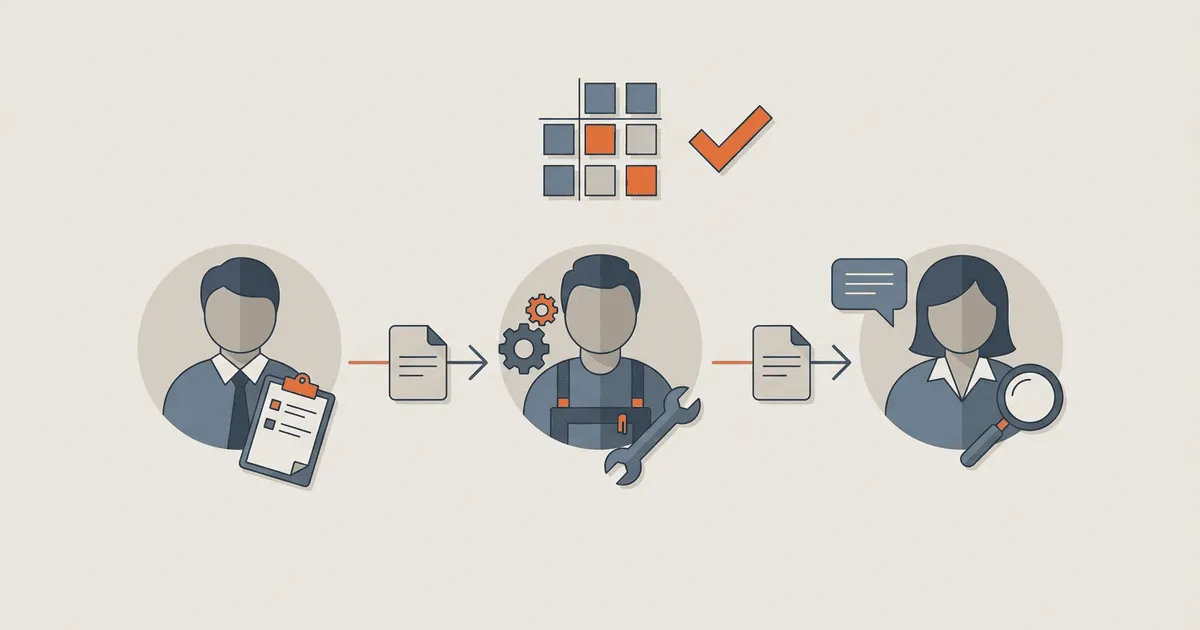
Work stalls when nobody owns context, approvals, exceptions, and launch decisions in a localization pipeline. When software teams ship multilingual applications, the process often breaks down at the boundaries between disciplines. Product managers write copy, engineers extract strings, and localization teams secure translations. Without a clear owner for each transition, translations arrive late, structural integrity fails, and linguistic quality drops. The failure mode is visible in missed deadlines and shipped defects: target strings contain broken placeholders, context is missing for translators, and bad translations reach production because no single role had the authority to block the release.
To resolve these bottlenecks, organizations must define a precise localization ownership model across product, engineering, and review functions. You need to assign an accountable owner for source string readiness, translation integrity, linguistic approval, and the final launch decision. This guide explains how to diagnose ownership gaps, implement a structured accountability model, handle release exceptions, verify your workflow, and take the next step toward continuous localization.
Diagnosing localization ownership gaps
The root cause of localization delays and defects is usually ambiguous accountability. In many organizations, localization is treated as an afterthought or a shared responsibility, which practically means no one is responsible. When a developer adds a new feature, they might quickly extract hardcoded strings without providing the necessary context. The localization vendor receives isolated words like "Charge" or "Post" without knowing if they function as nouns or verbs.
Practitioner reports confirm that this lack of context and ownership is a primary source of translation workflow pain. A community discussion on translation workflows indicates that linguistic quality and structural integrity require distinct review processes and different owners. When these roles blur, translators guess the meaning, developers merge unverified files, and product managers discover the errors only after the software reaches users.
You can identify ownership gaps by looking for specific symptoms in your development cycle. If your team frequently discovers missing translations during the final QA phase, the handoff between product and localization lacks an owner. If broken placeholders or malformed language files crash the application in specific locales, engineering has not taken ownership of structural validation. If translations are accurate but tonally wrong, the linguistic approval process is disconnected from product context. Addressing these symptoms requires a deliberate assignment of responsibilities.
Implementing a localization accountability model
A successful workflow requires a responsibility matrix. You must assign distinct owners for source readiness, structural integrity, linguistic quality, and release approval. This ensures that every phase of the translation lifecycle has a named individual or role accountable for its success.
Source readiness and context
Product management must own source string readiness. Before any string is sent for translation, the product owner must verify that the source text is final and that adequate context is provided. This includes screenshots, character limits, and explanations for ambiguous terms. Providing context is not optional; it is a fundamental requirement for accurate translation. The product manager is accountable for ensuring that the localization team has everything they need to understand the intent behind the words.
Structural integrity and validation
Engineering must own the structural integrity of localization files. Developers are responsible for ensuring that all target files conform to the required formats, placeholders are preserved, and syntax is correct. You should automate this verification to prevent human error. Implementing deterministic checks for missing keys and malformed files is essential. The i18n-validate project demonstrates how engineering teams can enforce these structural requirements in continuous integration pipelines. By automating integrity checks, developers can block invalid translations from merging into the main branch, taking clear ownership of technical correctness.
Linguistic quality and approval
The localization team, or designated in-country reviewers, must own linguistic quality. Engineering cannot validate grammar or tone, and product managers may not speak the target languages. The linguistic owner is accountable for ensuring that the translations are natural, culturally appropriate, and aligned with the brand voice. This role requires the authority to reject translations that meet structural requirements but fail qualitative standards.
Release decisions and exceptions
the product owner or release manager must own the launch decision. This role decides whether a locale with incomplete translations should default to English, use machine translation, or block the release entirely. To enforce this ownership, organizations can use version control policies. GitHub documents how to use required pull-request reviews to ensure that specific roles approve changes before they are merged. By configuring branch protection rules, you can mandate that both engineering (for structural integrity) and localization (for linguistic quality) approve translation updates before the release manager can deploy the software.
Integrating tools into the ownership matrix
Technology serves as the enforcement mechanism for your localization ownership model. Without integrated tools, accountability remains an abstract concept documented in a spreadsheet. To make ownership tangible, you must wire your continuous integration and continuous deployment pipelines to respect the boundaries you have established.
Tooling for product managers
Product managers require interfaces that surface the localization impact of their feature changes. When a product manager drafts new copy in a design tool, the integration should immediately flag strings that lack context or exceed established character limits for key target languages. Design-stage validation tools enable the product owner to resolve ambiguity before the text ever reaches a developer or a translator. product managers need dashboards that provide real-time visibility into translation completeness across all supported locales, empowering them to make informed release decisions rather than relying on delayed status reports.
Tooling for engineering teams
Engineering teams must leverage automation to maintain structural control. The continuous integration pipeline is the ultimate gatekeeper. Developers should configure automated linters that run on every commit, verifying that translation files contain valid JSON or YAML, that ICU MessageFormat syntax is strictly observed, and that no variables have been inadvertently dropped or renamed by translators. This automated enforcement shifts the burden of structural validation away from manual reviewers. When a pull request fails these checks, the system automatically assigns the remediation task back to the contributor, reinforcing engineering's ownership of file integrity.
Tooling for localization reviewers
Localization managers and in-country reviewers need platforms optimized for linguistic context rather than code management. Expecting translators to navigate raw repository files invites errors and frustration. The ownership model succeeds when reviewers are provided with dedicated translation management systems that present the source text alongside visual context, such as automated screenshots or live application previews. These platforms should enforce terminology consistency through integrated glossaries and translation memories. When a reviewer approves a string in this environment, the system should automatically generate a formatted commit back to the repository, preserving the separation of concerns.
Cultivating a culture of localization accountability
Structural changes and tooling integrations are necessary but insufficient without a corresponding shift in team culture. Localization must transition from a downstream chore to a first-class engineering and product requirement. This cultural shift begins during the onboarding process for new team members.
Educating cross-functional teams
New developers should receive explicit training on internationalization best practices, understanding how hardcoded strings and concatenated sentences break across different languages. They must understand that merging unverified target files is equivalent to introducing a syntax error into the main codebase. Similarly, product managers must be trained to view English copy not as the final product, but as the source code for a global user experience. They should learn to anticipate how colloquialisms, idioms, and culturally specific references will complicate the downstream workflow.
Establishing cross-team rituals
To maintain alignment, establish recurring rituals that bring the distinct owners together. A monthly localization review meeting can serve as a forum to discuss recurring bottlenecks, evaluate vendor performance, and prioritize internationalization debt. During project kickoffs for major new features, the localization owner should be present to highlight potential risks early in the design phase. These interactions build empathy and ensure that the boundaries between product, engineering, and review do not become isolated silos.
Rewarding localization excellence
recognize and reward teams that excel in executing their localization responsibilities. Highlight engineering teams that achieve zero structural translation defects in a quarter. Acknowledge product managers who consistently provide exemplary context that reduces translation turnaround time. By celebrating these successes, leadership reinforces the value of the localization ownership model and demonstrates that global readiness is a shared organizational priority.
Handling localization failures and exceptions
Even with a defined ownership model, exceptions will occur. A vendor might miss a deadline, a critical bug fix might require a last-minute string change, or a translation might introduce an unexpected layout issue. The ownership model must dictate exactly how to handle these failures without stalling the entire release.
Define an explicit exception path for incomplete locales. The release owner must have a documented protocol for when translations are late. This might involve falling back to the source language for the missing strings, delaying the release for that specific locale, or accepting a temporary machine translation. The key is that the decision is proactive and owned, rather than accidental.
When a bad translation reaches production, the incident response must be coordinated. The engineering owner is responsible for providing a rapid rollback mechanism, while the localization owner is responsible for correcting the defect in the source system. By separating the technical rollback from the linguistic correction, teams can restore service quickly and address the root cause systematically.
Verifying the ownership workflow
To verify that your localization ownership model is effective, track specific operational metrics. Do not rely on raw word counts or translation speed, as these metrics reward volume while hiding rework and defects.
Measure the cycle time from source finalization to linguistic approval. A high cycle time often indicates a bottleneck in providing context or a lack of clarity in the approval process. Track the first-pass acceptance rate of translations; a low rate suggests that the product team is not providing sufficient context during the handoff.
Monitor the frequency of build failures caused by malformed translation files. This metric directly reflects engineering's ownership of structural validation. If this number is high, you need stricter automated checks before the review stage. audit your release decisions. Check how many times incomplete locales were shipped by accident versus how many times they were shipped as a deliberate, documented exception by the release owner.
Taking the next action
Assigning names to these roles is the immediate next step. Review your current development pipeline and identify who currently signs off on source strings, who merges translation files, and who approves the final localized build. Document these assignments in a localization responsibility matrix and share it across the product, engineering, and localization departments. Configure your version control system to enforce these approvals programmatically. By making ownership explicit and enforceable, you eliminate the ambiguity that causes localization workflows to stall.
References
- GitHub: Protected branches supports using branch protection and required reviews to enforce ownership and approval gates.
- GitHub: i18n-validate provides authoritative technical guidance on automating structural integrity checks for translation files.
- Reddit: Localization workflow pain provides practitioner evidence that separating structural integrity from linguistic quality review is a critical workflow challenge.