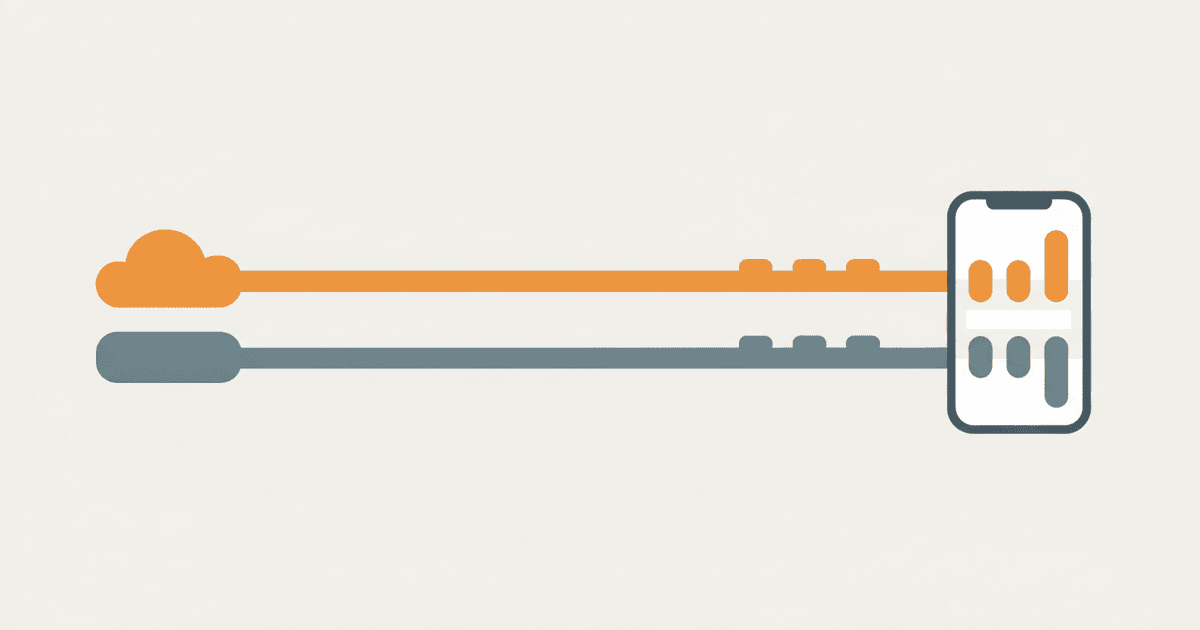
Mobile app content localization fails in a specific way: the navigation and buttons switch languages, but an article, product description, or onboarding card stays in English. The usual cause is not a missing string file. It is an API, CMS, and cache design that treats remote content as if it followed the same lifecycle as bundled UI copy.
Fix the boundary instead of adding another translation lookup. Remote content needs stable identities, explicit locale variants, its own publication state, locale-aware cache keys, and a defined offline fallback. With those pieces in place, changing the app language cannot accidentally reuse a stale representation from another locale.
Separate two localization lifecycles
Bundled UI strings and dynamic content have different owners and release clocks.
A label such as account.save belongs to application code. It must exist when the binary ships, and its placeholders must match the code that formats it. Android describes this default and locale-specific resource model in its app localization guide. The platform can choose a bundled resource without asking a server.
A help article or product description is different. An editor may update it after the binary release. It may have workflow states such as draft, translated, reviewed, scheduled, and archived. It may also be unavailable in one locale while a newer source version is already live.
Do not put both kinds of text behind one generic translate(key) interface. That hides the information needed to handle remote content safely. Use separate boundaries:
UI copy:       code key -> bundled locale resource -> formatted string
Remote content: content ID + locale -> published representation -> cached document
A shared translation platform can still manage both sets of text. The runtime contracts should remain separate. UI resources need key and placeholder integrity. Dynamic records need content identity, publication state, locale resolution, and versioned caching.
Model identity separately from language
A translated content record should be a representation of one stable item, not an unrelated record with a translated title. Start with an immutable content ID, then attach locale variants to it.
{
  "content_id": "onboarding.security-check",
  "source_version": 14,
  "variants": {
    "en": {
      "revision": 31,
      "status": "published"
    },
    "fr": {
      "revision": 27,
      "status": "published"
    },
    "fr-CA": {
      "revision": 9,
      "status": "review"
    }
  }
}
The app asks for the stable ID and a language preference. The content service chooses a published representation according to an explicit policy. It never infers that fr-CA is safe merely because a draft exists.
Keep source_version separate from the translated variant revision. When the English source changes from version 14 to 15, the French representation can remain published but should become stale for editorial purposes. Whether stale content remains visible is a product decision. The API must expose enough state for that decision instead of presenting every existing translation as current.
Translated slugs should not become database identity. Titles and paths can change during review, while links, analytics, favorites, and cache records still need a stable target. Point them to the immutable content ID.
Make locale negotiation observable
A mobile request can carry several signals: the user's saved app language, an operating system language list, an account preference, and a regional storefront. Pick one precedence policy and apply it before the request leaves the app.
For example:
- Use the explicit in-app language when the user selected one.
- Otherwise use the account language if the product synchronizes language across devices.
- Otherwise use the first supported operating system preference.
- Fall back to the product's source locale.
Send a canonical language tag or an ordered preference list. RFC 4647 language matching defines filtering and lookup over language priority lists. Adopt one matching scheme rather than creating endpoint-specific behavior.
A request might look like this:
GET /v1/content/onboarding.security-check
Accept-Language: fr-CA, fr;q=0.9, en;q=0.5
The response must state what the server actually selected:
HTTP/1.1 200 OK
Content-Language: fr
Vary: Accept-Language
ETag: "onboarding.security-check:fr:27"
The Content-Language field identifies the language intended for the representation under RFC 9110. The app should use that resolved value for cache storage, diagnostics, and analytics. Do not label the response fr-CA when it contains the generic French fallback.
The resolved locale makes mismatches visible. A QA log can show requested=fr-CA resolved=fr content_id=..., so a tester can tell whether the app, server, or CMS ignored the setting.
Key every cache by the resolved representation
A cache key containing only the content ID creates a predictable bug:
- The user opens an article in English.
- The app stores it under
article:42. - The user switches to French.
- The French request reads
article:42and displays the English body.
Include the resolved locale and representation revision:
content:{content_id}:{resolved_locale}:{revision}
The request cache may begin with the requested locale, but the persisted object should be moved or indexed under the locale returned by the server. This matters when fr-CA resolves to fr.
Store metadata beside the document:
{
  "content_id": "onboarding.security-check",
  "requested_locale": "fr-CA",
  "resolved_locale": "fr",
  "source_version": 14,
  "revision": 27,
  "etag": "onboarding.security-check:fr:27",
  "fetched_at": "2026-08-05T09:20:00Z"
}
Never flush every locale when the user changes language. Separate cache namespaces let a user switch back without downloading unchanged content. They also keep offline behavior predictable.
Use conditional requests for previously fetched variants. If the representation has not changed, the service can confirm the cached copy. If it has changed, replace the complete document atomically. Do not merge arbitrary translated fields from two revisions, because a title and body may have been reviewed together.
Define fallback before the network fails
Fallback has two separate jobs.
Language fallback chooses another published locale when fr-CA is unavailable, perhaps fr and then en. Availability fallback decides what the app shows when it cannot reach the service: the last known good fr representation, a bundled critical document, or an explicit unavailable state.
Write both policies down. A reasonable sequence for nonregulated onboarding content is:
- Use a current cached representation for the resolved locale.
- Fetch and atomically activate a newer published revision when online.
- If offline, use the last known good representation for that locale.
- If no locale-specific copy exists, use a deliberately approved source-locale fallback.
- If showing old or source-language content would be misleading, show an unavailable state instead.
Legal terms, prices, medical instructions, and time-sensitive promotions may require stricter rules. A stale translated record can be more dangerous than a visible unavailable state. Put the rule in content type configuration rather than relying on one global fallback.
Fallback should also preserve interface consistency. The surrounding button can remain in French while the article falls back to English, but the app should not claim that the article itself is French. Use the resolved locale for screen-reader language metadata and diagnostics when the platform surface supports it.
Keep publication state out of the app binary
A common shortcut is to return the newest existing locale variant. That can expose drafts. The API should return only variants that satisfy the publication policy for the requesting channel, audience, and app version.
At minimum, model these transitions:
source draft -> source published
translation missing -> translating -> review -> published
published -> stale after source change -> reviewed update -> published
The app needs the published representation, not the editorial work queue. The CMS or translation system needs the full state so reviewers can see that a source change affected existing locales.
A practitioner asking how to load mobile-app localization resources from a cloud CMS wanted to update text without a new app release. Downloading JSON solves only the transport. The design must also preserve the content model, review state, locale matching, and offline behavior.
For partial publication, choose a rule per content type. A marketing card may fall back to English. A locale-specific campaign should usually disappear when its translation is not published. A required onboarding disclosure may block release for that locale. These are editorial rules enforced by the content service, not ad hoc checks scattered through iOS and Android views.
Implement the workflow in a fixed sequence
Implement the layers in this order. Each step produces a contract that the next step can test.
1. Inventory remote content types
List every API or CMS field shown to users. Record its owner, source locale, freshness requirement, fallback rule, formatting variables, and whether offline access is required. Exclude server diagnostics and stable UI labels that belong in bundled resources.
2. Introduce stable content IDs
Remove translated titles and slugs from primary identity. Add a source version and per-locale revision. Preserve old IDs during migration so deep links and saved items still resolve.
3. Specify locale precedence and matching
Document the app preference order and the service's RFC 4647 lookup chain. Normalize supported tags at the boundary. Reject malformed tags instead of caching them as new locale namespaces.
4. Return resolution metadata
Include Content-Language, revision, source version, and an entity validator in every response. Add structured diagnostic fields if headers are difficult to inspect in mobile telemetry.
5. Isolate caches by locale
Migrate existing ID-only cache entries. Do not silently assign an old entry to the current language. Treat legacy entries as source-locale content only when that fact is known.
6. Connect translation state to publication
A source edit should mark affected locale variants stale. Publication should require the checks appropriate to the content type. The delivery API must never expose review drafts.
7. Add offline and rollback behavior
Retain the last known good representation per locale. Activate complete records atomically. Make it possible to withdraw one bad locale revision without deleting the source item or other languages.
Test failures that happy paths miss
A release test needs combinations, not one successful translated response.
Check an exact locale match, a regional fallback, and a source-locale fallback. Switch the app language after content has been cached. Start offline in each state. Publish a new source version while one translation remains stale. Withdraw one locale revision. Return a malformed language tag. Simulate two locale requests completing out of order. Confirm that the late English response cannot overwrite the active French screen.
Also inspect mixed screens. Record the UI locale, requested content locale, resolved content locale, content ID, revision, and cache outcome. A screenshot showing French buttons around English content is useful only when the log explains whether that was approved fallback or a defect.
Your automated contract tests should verify these rules:
same content ID + different locale -> different cache entries
regional locale missing -> documented fallback locale
translation in review -> never returned by delivery API
source changed -> affected translation reports stale
network failure -> last known good or explicit unavailable state
out-of-order response -> cannot replace content for active locale
Keep ownership boundaries clear
Do not let the mobile client reconstruct editorial fallback from raw CMS records. The service should select a publishable representation, while the client enforces display and cache safety.
Do not let the CMS become a replacement string bundle for ordinary UI. Bundled copy remains available at startup, participates in platform localization tooling, and ships with the code that formats it. Dynamic delivery is appropriate when content genuinely has an independent lifecycle. Where UI strings really do need updating between releases, that is a separate mechanism with its own compatibility rules, covered in shipping over-the-air app translation updates safely.
Do not let translators edit opaque JSON without content context. A dynamic record still needs field labels, screenshots or placement notes, variables, character constraints, source version, and approval history. Moving text to a CMS does not remove localization workflow requirements.
Verify the boundary before adding more locales
Pick one dynamic content type and trace it end to end. Confirm its stable ID, locale variants, source version, publication state, API matching rule, response language, cache key, offline fallback, telemetry, and rollback path. Then switch languages with the network disabled and again with one translation deliberately held in review.
If any layer cannot state which locale it requested, resolved, stored, or displayed, fix that ambiguity first. Only then extend the model to the rest of the app's remote content.
References
- RFC 9110 Content-Language defines the response metadata used to identify a representation's intended language.
- RFC 4647 language matching defines filtering and lookup for language ranges and priority lists.
- Android app localization guidance documents bundled default and locale-specific resources, the boundary contrasted with remote content delivery here.
- Stack Overflow: loading mobile app localization resources from a cloud CMS records the practitioner need to update localized mobile content outside an app release.