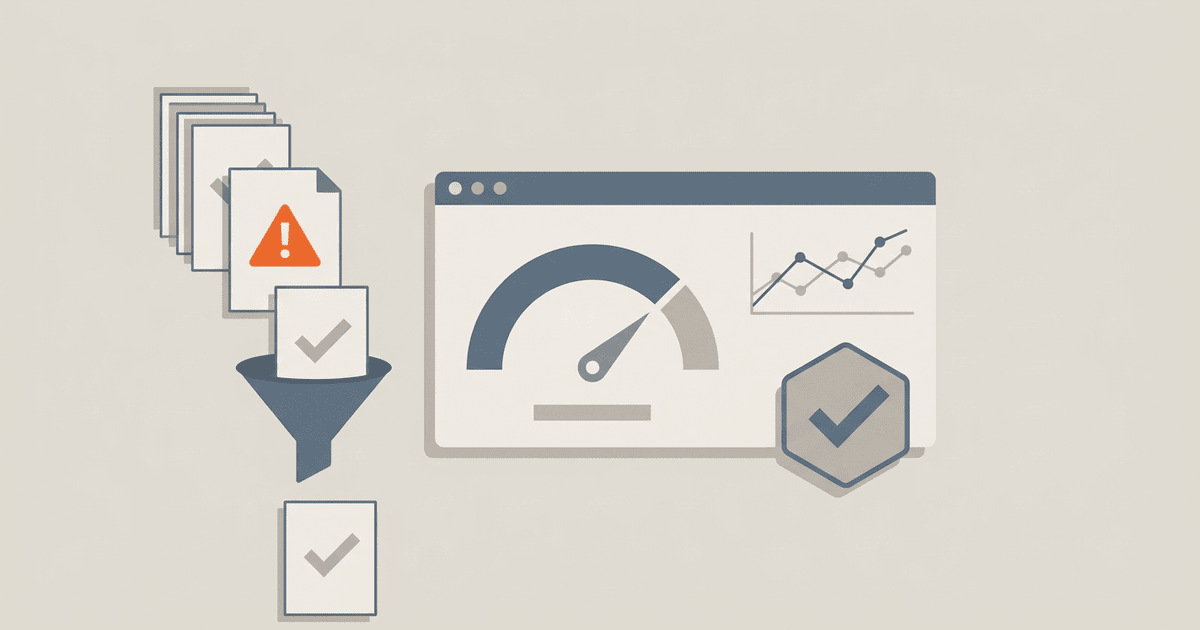
Counting translated words rewards volume while hiding stale targets, rework, broken placeholders, and late reviews. When teams measure translation speed alone, they often miss the actual pain points in the localization cycle. If your primary metric is words per day, you encourage fast, raw output. But if that output breaks the application layout, uses the wrong terminology, or requires multiple rounds of review to fix, the speed is an illusion. You need to track source-to-reviewed cycle time, first-pass integrity, reviewer rework, and locale launch completeness to get an accurate picture of localization health.
Why raw word counts fail the engineering pipeline
The fundamental failure mode of traditional localization metrics is treating all translated words as equal value. A thousand words of marketing copy might take a day to translate and review. A hundred UI strings might take a week because translators lack context, string IDs change, or placeholders break the build. Word counts fail to capture these crucial engineering distinctions.
If you measure only volume, you hide rework entirely. A string translated badly on Monday and fixed on Friday counts as a "completed" translation on Monday, making the team look fast while the release is blocked. This creates a dangerous disconnect between perceived progress and actual readiness.
You also ignore technical integrity. A translation that drops a crucial variable placeholder (like {username}) is technically invalid. A pure word-counting system doesn't know the difference between a safe string and one that will crash the client application. Furthermore, you miss the storefront requirements entirely. The application might be fully translated, but if the app store screenshots and release notes are missing, the locale cannot launch. Word counts do not capture launch readiness across the entire product surface.
The payoff for changing your measurement strategy is predictability. When you measure cycle time and integrity, you can accurately forecast when a new locale will be ready to ship. You can also identify which parts of your process handoff, translation, review, or QA are causing the most delay and target your engineering efforts accordingly.
Diagnosis: identifying the metric gaps
Before you can fix your metrics, you have to diagnose what is currently being measured and where the blind spots are. Look at your current localization dashboards or vendor reports to find the gaps in your observability.
Speed is often measured from the moment strings are exported to the moment they are imported back. But what happens in between? If a translator has to stop and ask five questions about the context of a string, that time is often not captured in the "translation time" metric because the string is sitting in a pending state. The clock is paused, hiding the friction.
Quality is often measured by Linguistic Quality Assurance scores. These are subjective and often happen too late in the process. If a reviewer flags a string for incorrect terminology, that string goes back to the translator. This loop can happen multiple times. If your metrics only capture the final quality score, you completely miss the engineering cost of those repetitive rework loops.
Implementation: building better localization metrics
To get an accurate picture of localization health, you need to measure the entire pipeline, from the moment a string is created in the codebase to the moment it is approved and ready for production.
Measure source-to-reviewed cycle time
Cycle time is the most important metric for predictability. It measures the total time a string takes to go from new in the source language to reviewed and approved in the target language.
This metric includes the time the string waits to be sent to translation, the time spent translating, the time spent waiting for review, and the time spent in rework loops. By measuring the entire cycle, you capture the hidden delays. If translation takes one day but review takes four days, your cycle time is five days. This tells you that you need to optimize your review process and unblock reviewers, rather than pressuring translators for more speed.
Track first-pass integrity
First-pass integrity measures the percentage of translations that pass automated technical checks on the first try, without requiring human intervention. Technical checks should include placeholder validation, pluralization rules, and markup preservation.
Does the target string contain all the variables present in the source string? Does it correctly implement the plural rules for the target language? Does it preserve essential HTML or UI markup? Does it fit within the maximum allowed length for its UI container?
You can automate these checks using dedicated tooling. For example, the i18n-validate checks provide machine-readable integrity outcomes that you can integrate directly into your CI pipeline. When a translation fails these checks, it should be automatically rejected, and the failure should be logged as a strike against first-pass integrity.
Measure reviewer rework ratios
Reviewer rework measures how often a translation is sent back to the translator for correction after it has passed automated checks.
High rework rates usually indicate a lack of context. If translators don't know where a string appears in the UI, they will guess, and reviewers will have to correct those guesses. By tracking rework rates per language, per project, or per translator, you can identify where context is missing and provide better reference materials, screenshots, or design files.
Track locale launch completeness
A locale is not ready to launch just because the UI strings are translated. You also need translated app store metadata, screenshots, release notes, and support documentation. Locale launch completeness measures the percentage of required assets that are ready for a specific locale.
You can define a checklist for each locale that includes UI strings, store titles, descriptions, screenshots, and critical support articles. When you measure completeness across all these surfaces, you stop pretending that a locale is ready just because the code itself is localized.
Decision rules for metric evaluation
When evaluating your new metrics, use these decision rules to drive concrete engineering action:
First, if cycle time is high but rework is low, the delay is likely in handoff or waiting for review. Automate the handoff process and set SLAs for reviewers to prevent strings from sitting idle in the queue.
Second, if first-pass integrity is low, the translators are making technical errors. Improve your automated checks, provide better tooling for translators, and ensure they understand the specific placeholder syntax your framework requires.
Third, if rework is high, translators lack context. Provide screenshots, character limits, and terminology glossaries along with the source strings. Stop sending raw JSON files without visual references.
Finally, if locale completeness is lagging UI translation, your non-code localization processes are disconnected from your software development lifecycle. Integrate marketing and support localization into the main release train so everything ships together.
Automating metric collection in ci/cd
To make these metrics useful, you need to collect them automatically. Manual reporting is too slow, prone to errors, and rarely looked at by engineering teams. You can use standard CI/CD platforms to run your integrity checks and store the results for historical analysis.
GitHub Actions documents how to use workflow artifacts that can retain reports for trend analysis. By archiving the validation outputs, you can build dashboards that show how your first-pass integrity trends over time.
Here is a practical example of a workflow that runs validation and saves the report:
name: Localization Validation

on:
  pull_request:
    paths:
      - 'locales/**/*.json'

jobs:
  validate:
    runs-on: ubuntu-latest
    steps:
      - uses: actions/checkout@v4

      - name: Run i18n-validate
        run: npx i18n-validate --locales ./locales --report ./report.json

      - name: Archive validation report
        uses: actions/upload-artifact@v4
        with:
          name: i18n-validation-report
          path: ./report.json
By storing the report as an artifact, your data team can download it later and aggregate the data to calculate the exact first-pass integrity percentage for every release cycle.
Handling failures and edge cases
When transitioning to these new metrics, you will inevitably encounter edge cases that complicate your data.
The false positive integrity failure
Sometimes an automated check will fail a translation incorrectly. For example, a target language might legitimately not need a placeholder that was present in the source because the grammar requires a different structure. You need a mechanism to bypass checks for specific strings, usually via a comment or configuration file. When this happens, the bypass should be logged, but it should not count against the first-pass integrity score.
The stale translation problem
If a source string changes slightly, perhaps to fix a minor typo, the target strings might technically still be valid, but they are now out of sync with the new source. Your cycle time metric needs to account for this drift. When a source string changes, the translation should be marked as needing review, and the cycle time clock should start again.
Deep dive: the hidden cost of stale strings
Stale strings are one of the most insidious problems in continuous localization. When developers update the English source text perhaps to clarify a confusing instruction or update a brand name the translation files often remain untouched if the key hasn't changed. The translation memory assumes the string is complete. But the target users are now seeing outdated instructions. Measuring throughput by looking at the percentage of translated keys gives a false sense of security.
To combat this, you must track string freshness. Implement a system that hashes the source string and stores that hash with the translation. If the source changes, the hash changes, and the translation is immediately flagged as stale. This creates a rework task, which correctly impacts your cycle time and completeness metrics, preventing you from shipping a falsely localized application.
Setting up a cycle time dashboard
To effectively measure cycle time, you need a dashboard that aggregates data from your localization management platform and your version control system. You can build this using standard data engineering tools. Extract the event logs from your Translation Management System via API.
You are looking for specific timestamps: when a string was created, assigned, submitted by the translator, and approved by the reviewer. Load this data into a data warehouse and visualize it using a BI tool. You can then create charts showing the median cycle time, the 90th percentile cycle time, and the breakdown of time spent in each state. This level of visibility transforms localization from a black box into an observable engineering process.
The role of automation in first-pass integrity
First-pass integrity is heavily reliant on robust automation. Relying on human reviewers to spot a missing HTML tag or a mismatched plural form is a recipe for failure. Humans are bad at syntax checking; automation is excellent at it.
Integrate a linter directly into the translator's workbench if possible, or run it immediately upon commit. The linter should verify that all required variables exist, that no forbidden variables were added, that the string does not exceed character limits, and that the syntax of any plural expressions is perfectly formed. By failing the build early, you prevent broken strings from ever reaching the QA stage.
Calculating reviewer rework ratios systematically
The rework ratio is a powerful diagnostic tool. Calculate it by dividing the number of strings sent back to translation by the total number of strings submitted for review. If this ratio is consistently high, you have a systemic issue.
It might be a poorly trained vendor, a lack of visual context, or ambiguous source copy. Practitioners often cite this exact opaque back-and-forth as their primary localization workflow pain. Dig into the data to find the root cause. Is the high rework ratio isolated to a specific language? That might indicate a problem with that specific linguist. Is it isolated to a specific feature? That indicates a lack of context or particularly difficult terminology. Slicing the rework data helps you fix specific process failures.
Bridging the gap between code and content teams
Locale launch completeness requires bridging the gap between the engineering team and the marketing teams. Often, these teams use different tools and operate on entirely different schedules. To measure completeness accurately, you need a unified view.
This might involve creating a meta-issue in your project management tool for each locale launch. This epic should contain sub-tasks for the UI translations, the app store metadata, the localized screenshots, and the required support articles. Only when all sub-tasks are closed is the locale considered fully complete and ready for release.
Rehearsing locale-specific rollbacks
What happens when a critical localization error slips through despite your best metrics? You need a reliable rollback plan. If a translated string introduces a crash, you must be able to disable that locale without rolling back the entire application release for all users.
This is where feature flags and dynamic resource loading come in. Architecture your application so that you can dynamically force a locale to fall back to the default language via a remote configuration change. Rehearse this scenario in a staging environment to verify that your team can execute the locale-specific rollback within your required SLA.
Overcoming resistance to new metrics
When you introduce these new metrics, expect pushback. Translators and vendors who are used to being evaluated on speed and volume may feel threatened by metrics that highlight rework and cycle time. Address these concerns directly.
Explain that the goal is not to punish individuals, but to identify systemic bottlenecks and missing context. If rework is high because context is missing, the solution is to provide better context, not to blame the translator. By framing these metrics as tools for process improvement, you can foster a culture of continuous improvement.
The long-term impact on localization roi
By shifting your focus from volume to throughput and integrity, you ultimately improve the return on investment of your localization efforts. You spend less time fixing broken builds, less time waiting for rework, and more time delivering high-quality localized experiences to your users.
Your releases become predictable. Your engineers stop dreading localization bugs. And your international users receive an app that feels native and polished, driving higher engagement and conversion rates. Measuring the right things is the essential first step toward building a mature localization operation.
Verifying the solution
How do you know if your new metrics are actually working? You verify the solution by looking at your release predictability. Before implementing these metrics, you probably experienced last-minute delays due to broken placeholders or missing translations. After implementing these metrics, those surprises should disappear.
You should be able to look at a dashboard and say confidently that a specific language is at 95 percent completeness and 98 percent integrity, meaning it will be ready to ship on Thursday. If your forecast consistently matches reality, your metrics are working as intended.
Next actions
Moving away from pure word counts requires a shift in mindset. You have to value predictability and technical correctness over raw volume. By measuring cycle time, integrity, rework, and completeness, you align your localization metrics with your software release goals.
Your next step is to audit your current localization reporting. Identify one metric you can replace or augment. Set up a simple automated check for placeholder integrity and start tracking the failure rate. Use that data to have a conversation with your localization team about quality, not just speed.
References
- i18n-validate checks - Tooling for machine-readable localization integrity outcomes.
- workflow artifacts - Documentation on retaining CI/CD reports for trend analysis.
- Reddit: Localization workflow pain - Community discussion highlighting the pain points of opaque translation and review processes.