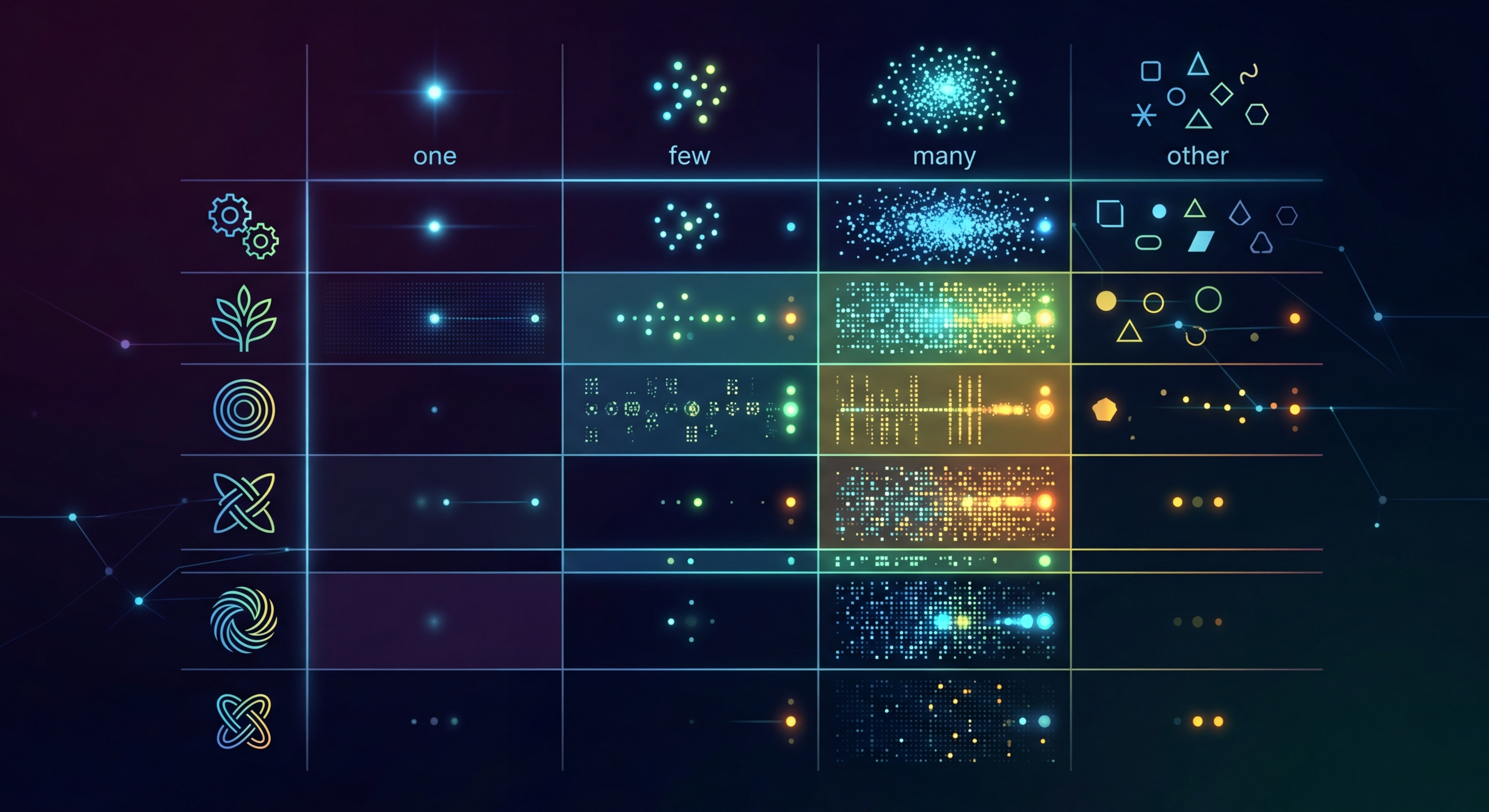
Reguły liczby mnogiej CLDR: weryfikacja kategorii i18n w różnych językach
Angielski ma 2 formy liczby mnogiej, arabski 6, a rosyjski 4. Jeśli konfiguracja i18n obsługuje tylko kategorie 'one' i 'other', aplikacja nie działa poprawnie w większości języków. Ten przewodnik wyjaśnia reguły CLDR i sposób ich weryfikacji.
Czym są reguły liczby mnogiej CLDR?
Standard Unicode CLDR (Common Locale Data Repository) definiuje sześć kategorii liczby mnogiej: zero, one, two, few, many i other. Każdy język korzysta z części tych kategorii zgodnie z własnymi regułami liczbowymi. Angielski używa one (dokładnie 1) oraz other (wszystkie pozostałe wartości). Większość języków ma jednak bardziej złożone zasady, a błędne formy prowadzą do niegramatycznych tekstów i obniżają wiarygodność aplikacji.
// English has 2 plural forms: one, other
// "1 item" vs "2 items"

// But many languages have more:
// Arabic: 6 forms (zero, one, two, few, many, other)
// Polish: 3 forms (one, few, other)
// Japanese: 1 form (other)
// Czech: 3 forms (one, few, other)

// If you only provide "one" and "other",
// Arabic and Polish users see broken text.Sześć kategorii liczby mnogiej
CLDR definiuje dokładnie sześć kategorii liczby mnogiej. Nie każdy język korzysta ze wszystkich — angielski używa tylko dwóch, a arabski wszystkich sześciu. Pliki i18n muszą zawierać kategorie wymagane przez każdy język docelowy. W przeciwnym razie użytkownicy zobaczą awarie, nieprzetworzone klucze lub niegramatyczny tekst.
// CLDR defines 6 plural categories:
// zero  - 0 items (Arabic, Latvian)
// one   - 1 item (most languages)
// two   - 2 items (Arabic, Welsh)
// few   - 2-4 items (Polish, Czech, Russian)
// many  - 5-19 items (Arabic, Polish, Russian)
// other - everything else (required for ALL languages)

// Examples by language:
// English:  one, other                    (2 forms)
// French:   one, many, other              (3 forms)
// Arabic:   zero, one, two, few, many, other  (6 forms)
// Japanese: other                         (1 form)
// Polish:   one, few, many, other         (4 forms)
// Russian: one, few, many, other (4 forms)Kategorie liczby mnogiej według języka
Podręczna lista kategorii wymaganych w popularnych językach docelowych. Skorzystaj z niej podczas definiowania form liczby mnogiej w plikach tłumaczeń.
// MISTAKE 1: Only providing "one" and "other"
// en.json
{
  "items_one": "{{count}} item",
  "items_other": "{{count}} items"
}
// This breaks for Arabic (missing zero, two, few, many)

// MISTAKE 2: Hardcoded plural logic
// WRONG:
const text = count === 1 ? "1 item" : `${count} items`
// This fails for languages where "1" isn't the only "one" form

// MISTAKE 3: Missing "other" category
// "other" is REQUIRED for every language
// Without it, some numbers show raw keys

// MISTAKE 4: Translating plural RULES instead of text
// The CLDR rules (one, few, many) are universal
// Only the TEXT after each rule should be translatedAutomatyczna walidacja liczby mnogiej
i18n-validate sprawdza, czy każdy klucz liczby mnogiej w plikach tłumaczeń definiuje wszystkie kategorie CLDR wymagane przez język docelowy. Jeśli plik rosyjski zawiera tylko formy 'one' i 'other', narzędzie zgłasza brak kategorii 'few' i 'many' jako błędy. Uruchamiaj je w CI, aby wykrywać problemy, zanim zobaczą je użytkownicy.
# Validate plural forms match CLDR requirements
npx i18n-validate --check-plurals \
  --source locales/en.json \
  --targets 'locales/*.json'

# Output:
# locales/ar.json:
#   items: missing plural forms: zero, two, few, many
#   Expected: zero, one, two, few, many, other
#   Found: one, other
#
# locales/pl.json:
#   items: missing plural forms: few, many
#   Expected: one, few, many, other
#   Found: one, other

# Fix: Add all required forms for each language
# See https://unicode.org/cldr/charts/latest/supplemental/language_plural_rules.htmlICU MessageFormat dla liczby mnogiej
Zalecanym sposobem definiowania tłumaczeń liczby mnogiej jest ICU MessageFormat. Wykorzystuje on jeden ciąg znaków z osadzonymi regułami: {count, plural, one {# item} other {# items}'}. ICU jest obsługiwany przez react-intl, vue-i18n, Angular Transloco, Flutter i większość nowoczesnych frameworków i18n.
// ICU MessageFormat handles plurals correctly
// It uses CLDR rules internally

// en.json
{
  "items": "{count, plural, one {# item} other {# items}}"
}

// ar.json
{
  "items": "{count, plural, zero {لا عناصر} one {عنصر واحد} two {عنصران} few {# عناصر} many {# عنصرًا} other {# عنصر}}"
}

// pl.json
{
  "items": "{count, plural, one {# element} few {# elementy} many {# elementów} other {# elementu}}"
}

// ICU also handles ordinals:
{
  "ranking": "{pos, selectordinal, one {#st} two {#nd} few {#rd} other {#th}}"
}# Validate ICU message syntax
npx i18n-validate --check-icu \
--source locales/en.json \
--targets 'locales/*.json'
# Catches:
# - Missing plural categories for the target language
# - Syntax errors in ICU messages
# - Mismatched variable names
# - Missing "other" (always required)Wypróbuj i18n Agent
Upuść tutaj plik tłumaczenia
JSON, YAML, PO, XML, CSV, Markdown, Properties
lub kliknij, aby go wybrać
Języki docelowe