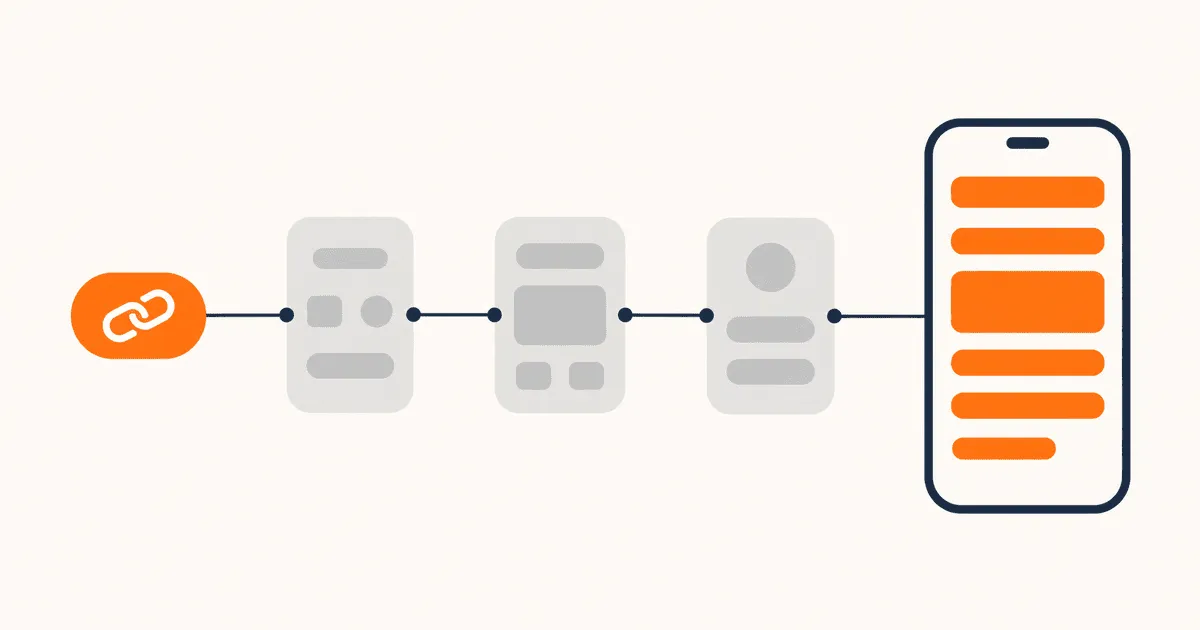
Localized mobile deep links often open the correct screen in the wrong language. A French campaign link reaches the intended offer, but a cold app start restores English. An authenticated redirect drops the locale. An uninstalled user sees a localized web page, installs the app, and then lands on a generic home screen. The link technically works, yet the customer journey does not.
A routing contract fixes this failure. It defines where locale context comes from, how long it lasts, and what happens when the URL conflicts with the saved app preference or device language. The implementation belongs at the app boundary, backed by tests for every route state that can discard language context.
Why locale context disappears
A deep link crosses systems that usually own language independently. The campaign platform selects a language for the message. The website may put a locale in the path. The operating system chooses an installed app or browser. The app stores its own language preference. Authentication may introduce another redirect. If each layer makes a fresh locale decision, the last layer can silently override all earlier decisions.
Platform link verification solves a different problem. Apple explains how Universal Links associate an HTTPS domain with an app, allowing the same URL to open app content when the app is installed and web content otherwise. Android documents how deep links and verified App Links route web URLs into activities. Neither mechanism decides whether a locale hint should replace a user's saved app language. That policy belongs to the product.
Cold starts make the boundary more visible. The app may render its initial route before link delivery and language initialization finish. A reproducible Flutter cold-start routing issue reports an iOS path where the root route is processed immediately before the intended deep-link path. Even if a particular framework fixes that behavior, the architecture still needs to tolerate asynchronous route delivery without flashing the wrong locale or recording an incorrect analytics screen.
A second source of failure is treating translated URL text as application identity. If /fr/offres/ete and /de/angebote/sommer become separate internal route names, every translation change becomes a routing migration. Old emails and notifications keep circulating after copy changes. Stable route identity should not depend on translated labels.
Start with a locale precedence contract
Write the precedence order before changing routing code. A practical default is:
- An explicit, valid locale hint on a trusted link may control the linked journey.
- A saved in-app language preference controls ordinary navigation.
- The operating system's per-app language setting applies when the app has no saved preference.
- Device language and the product default are final fallbacks.
This order is a product decision, not a platform guarantee. Some products should never let a campaign link change the app's persistent language. They can use the link locale for the destination screen while leaving the saved preference alone. Other products treat an explicit language URL as a deliberate user choice. Either policy can work if the app applies it consistently instead of accepting whichever value initializes first.
Android's per-app language guidance describes system settings and application APIs for selecting supported locales. That preference is useful input, but a deep-link handler still needs to decide whether a URL hint is temporary, persistent, or ignored. On the web side, the long-running SvelteKit internationalization design discussion captures the related URL decision: putting language in the path makes the preference explicit and removes ambiguity that cookies or implicit detection can introduce.
Define the contract as data so every client can implement the same rules:
{
  "supportedLocales": ["en", "fr", "de", "ja"],
  "defaultLocale": "en",
  "linkLocaleMode": "journey-only",
  "precedence": [
    "validated-link-hint",
    "saved-app-preference",
    "system-app-language",
    "device-language",
    "default-locale"
  ]
}
journey-only means the link controls the linked flow but does not rewrite the account or app preference. A product that wants explicit localized URLs to persist can use a separate mode, such as persist-explicit-link, and require a visible language switch or confirmation for sensitive account journeys.
Keep route identity separate from language
Use a stable content or route identifier in the application. Put the locale in a dedicated segment or validated parameter rather than translating the internal route name.
For example, two public URLs can share one route identity:
example.com/fr/app/offer/summer-2026
example.com/de/app/offer/summer-2026
Both URLs map to route ID offer and object ID summer-2026. The localized web path may differ for search or editorial reasons, but the app association layer should normalize it into the same internal command:
OpenOffer(
  offerId = "summer-2026",
  localeHint = "fr",
  source = "email"
)
Do not pass a translated screen name and ask the app to infer which controller it means. Do not use arbitrary URL locale text directly as a resource lookup key. Parse the value, normalize its case and separator conventions, and match it against the app's supported locale list. If the hint is unsupported, continue with the saved preference rather than constructing a partial locale state.
The same rule applies to fallback web pages. A URL that opens a French app route should display a French web destination when the app is absent. Universal Links and App Links are valuable because one HTTPS URL can represent both destinations. Keep the route and locale semantics equivalent on both surfaces, even when their rendering stacks differ.
Resolve language before rendering the destination
Treat deep-link intake as an initialization phase, not a navigation callback that can fire at any point without coordination. The app needs one gate that waits for three inputs:
- the incoming link, if one exists;
- the persisted app or account preference;
- the platform language state.
Then resolve the locale once and build the destination. The following pseudocode makes the order explicit:
function resolveDeepLink(url, savedLocale, systemLocale):
    command = parseAndVerify(url)
    hint = normalizeSupportedLocale(command.localeHint)

    if hint exists and policyAllows(command, hint):
        resolvedLocale = hint
        persistence = policyPersistence(command)
    else if savedLocale is supported:
        resolvedLocale = savedLocale
        persistence = "unchanged"
    else if systemLocale is supported:
        resolvedLocale = systemLocale
        persistence = "unchanged"
    else:
        resolvedLocale = defaultLocale
        persistence = "unchanged"

    loadMessages(resolvedLocale)
    destination = authorize(command.routeId, command.objectId)
    render(destination, resolvedLocale)
    recordLinkOutcome(command, resolvedLocale, persistence)
parseAndVerify should reject unknown hosts, malformed paths, unsupported route IDs, and unexpected parameters. Link verification at the operating-system layer reduces hijacking risk, but the application must still validate every command it derives from a URL. A verified domain does not make every path or identifier safe.
Load the selected messages before showing the linked destination. If message loading is asynchronous, display a neutral launch surface rather than rendering the default language and replacing it moments later. Also delay the destination analytics event until the final route and locale are known. Otherwise one visit can appear as both a home-screen view and an offer view, which hides cold-start defects.
Handle authentication without dropping the locale
Authentication commonly breaks an otherwise correct implementation. The app receives a link, discovers that the user is signed out, opens sign-in, and then reconstructs only the destination path. The locale hint disappears because it was treated as a URL decoration instead of part of the pending navigation command.
Store a bounded continuation object before starting authentication:
{
  "routeId": "offer",
  "objectId": "summer-2026",
  "resolvedLocale": "fr",
  "source": "email",
  "createdAt": "2026-07-30T12:00:00Z"
}
Keep only fields required to resume the route. Give the continuation a short lifetime, validate it again after authentication, and never place credentials in the deep link. When sign-in completes, restore the resolved locale before constructing the destination screen.
Account preferences can create a legitimate conflict. A signed-out French campaign may lead to an account whose explicit language is German. Decide whether the campaign language applies only through sign-in, through the destination, or not at all after account identity becomes available. Document this as a decision table. Do not let a random callback order choose the result.
Design safe fallbacks for missing content
A supported interface locale does not guarantee that the linked object exists in that locale. The route resolver should distinguish three failures:
- unsupported interface locale;
- supported locale with missing object translation;
- missing or unauthorized object.
For an unsupported locale hint, fall back through the precedence contract. For missing translated content, keep the interface in the resolved locale and show the object in a declared fallback language, if product policy permits it. Tell the user which content fell back. For a missing or unauthorized object, show the normal localized error route without exposing whether a protected object exists.
Do not redirect all failures to the home screen. That makes broken links look successful and removes the evidence needed to fix them. Return a reason code to analytics and logs, such as unsupported_locale, content_fallback, expired_object, or auth_required. Keep user-facing text in the app's normal localization resources.
Test the route matrix, not one happy path
A link that works while the app is already open proves very little. Build a compact matrix around state transitions:
| App state | Account state | Locale conflict | Expected check |
|---|---|---|---|
| Installed and cold | Signed in | Link differs from saved locale | One render in the contract-selected locale |
| Installed and warm | Signed in | No conflict | Existing stack does not override the destination |
| Installed and cold | Signed out | Link has locale | Sign-in continuation preserves locale and route |
| Not installed | Signed out | Localized URL | Web fallback uses the same locale and content identity |
| Installed | Signed in | Unsupported link locale | Saved or system preference wins cleanly |
| Installed | Signed in | Translation missing | UI locale remains stable and content fallback is disclosed |
| Installed | Signed in | Malformed route | Localized error appears and no unsafe command runs |
Run this matrix on physical iOS and Android devices, not only simulators. Test links from email, messaging apps, QR codes, browser address bars, notifications, and any paid campaign redirector. Notification payloads are a frequent source of these links, so pair this matrix with the checks for localized app push notifications. Intermediaries may rewrite URLs or add parameters. Verify the final URL delivered to the app, not merely the URL created by marketing.
For each case, capture the received URL, normalized route ID, locale hint, selected locale source, final locale, app state, and result code. Avoid logging personal content or full sensitive parameters. The goal is to identify which boundary discarded context without turning routing logs into a privacy problem.
Common implementation mistakes
Persisting every link locale is a common error. A user who selected Japanese can open one English support link and find the whole app switched afterward. Keep a temporary journey locale separate from a durable preference.
A verified domain does not make its locale parameter trustworthy. Validate locale values and route IDs against allowlists, and treat every link parameter as untrusted input.
Translated internal route names also age badly. Stable identifiers survive copy edits and reused campaigns. Translate labels and web slugs at the presentation layer instead.
If the app renders before locale resolution, users can see a language flash and analytics can record two screens for one visit. Hold the destination until the language decision is complete.
Finally, a warm-app test misses the difficult transitions. Cold start, installation fallback, authentication, and expired content are where independent state machines collide.
Verify the contract before launch
A release is ready when the same test link produces a predictable result across every state in the matrix. Confirm that platform association files are valid, the app accepts only intended hosts and routes, locale hints normalize to supported values, authentication resumes the full command, and fallback pages preserve route identity.
Then run one real campaign-shaped test per launch locale. Use the actual redirect chain and final production domain. Open each link with the app warm, cold, signed out, and absent. Confirm the visible language, destination, analytics event, and fallback reason. If any layer makes a different locale choice, fix the precedence implementation rather than adding another route-specific exception.
Write a one-page locale precedence table and add it to the deep-link test plan. Ask product, mobile, web, and lifecycle owners to approve each conflict case before the next campaign ships. That turns implementation into a deterministic routing problem instead of a sequence of language guesses.
References
- Apple: Allowing apps and websites to link to your content supports the Universal Link association and app-to-web routing model.
- Android Developers: About deep links supports Android deep-link and verified App Link behavior.
- Android Developers: Per-app language preferences supports the platform language-preference layer used by the precedence contract.
- Flutter issue 142988: Cold-start deep-link routing supplies a reproducible practitioner report about root-route processing before the intended iOS deep link.
- SvelteKit issue 553: Internationalization design supports the adjacent language-in-URL design problem and the value of explicit locale paths.