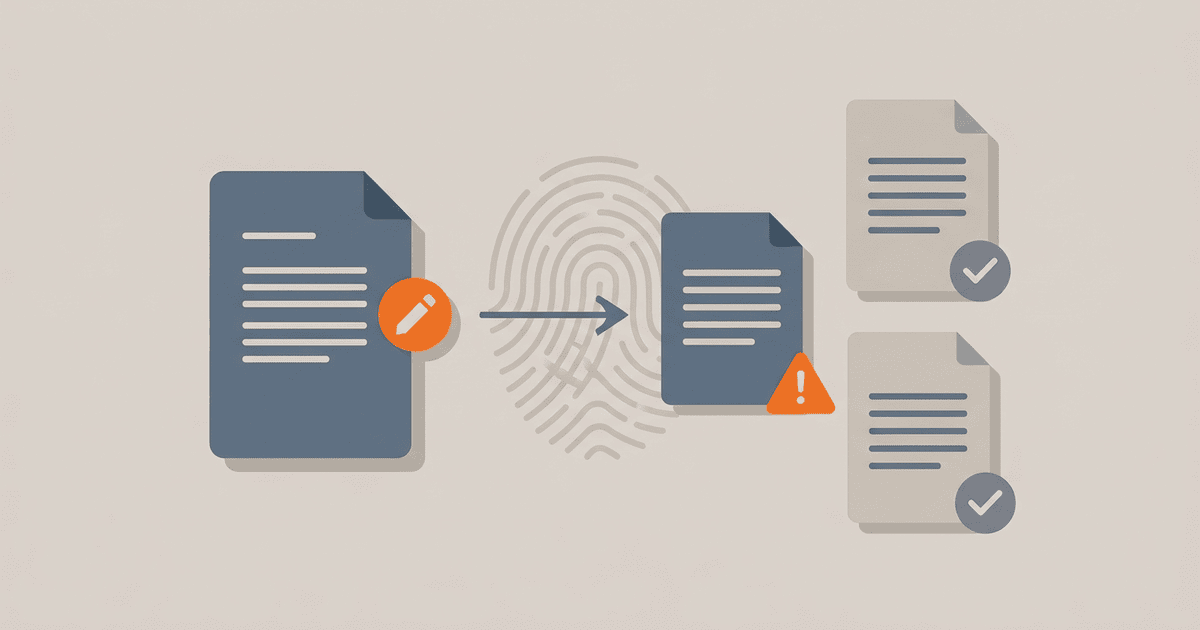
Software development moves fast, and user interface copy changes constantly. When developers update a source string to clarify meaning, change a call to action, or fix a confusing label, the translation keys usually remain exactly the same. The failure mode is insidious: the localization system sees that the key exists in the target languages and incorrectly assumes the translation is complete. This disconnect creates translation drift, where the application displays outdated, incorrect, or even legally dangerous localized text that no longer reflects the source meaning.
To solve this, engineering teams must stop relying on simple key existence to validate translations. Instead, you need a robust implementation that uses source fingerprints to track the exact text that was originally translated. By hashing the source string and validating it during continuous integration, you can automatically mark affected targets as stale and require a new review after material copy changes. This article details how to build a continuous localization pipeline that guarantees translation freshness and eliminates source drift.
The problem with key-based translation matching
Traditional localization systems operate on a simple associative array model. A unique string identifier, such as button_checkout_confirm, maps to a source value like "Confirm Order" in English. In the target language file, the same identifier maps to the localized equivalent, such as "Commande de confirmation" in French.
When a developer changes the English source string from "Confirm Order" to "Pay Now and Confirm," the underlying identifier button_checkout_confirm does not change. The application build process checks the French localization file, finds the button_checkout_confirm key, and compiles the application. The system reports 100% localization coverage, and the continuous integration pipeline passes.
But the French user still sees the translation for "Confirm Order," completely missing the new financial context of "Pay Now." This structural flaw is the root cause of translation drift. Relying on key parity validates the structure of the localization files but ignores the semantic integrity of the actual content.
This failure cascades across the entire software development lifecycle. Quality assurance testers validating the application might not speak the target language and will assume the presence of localized text means the feature is working correctly. Translators are never notified of the change because the localization platform only surfaces missing keys, not keys where the underlying source has silently shifted.
Architectural solution: source fingerprinting
To prevent translation drift, the localization architecture must decouple structural validation (does the key exist?) from semantic validation (is the translation still accurate for the current source?). The most effective pattern for this is source fingerprinting.
Source fingerprinting involves generating a cryptographic hash of the exact source string at the moment it is submitted for translation. This hash is then stored alongside the localized string in the target language files or within the translation management system's database.
Implementing fingerprint generation
When extracting strings from the codebase, the localization pipeline should calculate a hash, typically using a fast algorithm like SHA-256.
const crypto = require('crypto');

function generateFingerprint(sourceString) {
  return crypto
    .createHash('sha256')
    .update(sourceString.trim())
    .digest('hex');
}

// Example usage
const sourceText = "Pay Now and Confirm";
const fingerprint = generateFingerprint(sourceText);
// fingerprint: "a1b2c3d4e5f6..."
This fingerprint acts as an immutable lock. When the French translation is completed, it is associated not just with the key button_checkout_confirm, but specifically with the fingerprint a1b2c3d4e5f6....
Validation during continuous integration
During the continuous integration (CI) build process, the validation step recalculates the fingerprint for the current source string found in the codebase. It then compares this newly calculated fingerprint against the fingerprint stored with the translation.
If the developer changes the source string to "Submit Payment," the newly calculated fingerprint will be completely different. The CI pipeline will detect a mismatch between the current source fingerprint and the stored translation fingerprint. Instead of passing, the CI step flags the French translation as stale, potentially failing the build or automatically routing the string back to the translation queue for a new review.
This approach shifts the paradigm from key-based parity to content-based integrity. The continuous localization guide demonstrates how integrating hash-based freshness tracking directly into the CI pipeline ensures that no stale string can reach production without explicit authorization.
Platform implementations of source change management
While custom fingerprinting is necessary for some bespoke workflows, many established localization frameworks and platforms already implement mechanisms for managing source string changes. Understanding these built-in solutions provides a blueprint for robust string lifecycle management.
GNU gettext and fuzzy entries
One of the oldest and most mature localization systems, GNU gettext, explicitly addresses the problem of source string changes through the concept of "fuzzy" entries.
When a source string in a codebase is updated, the gettext msgmerge utility compares the new extraction with the existing translation catalog (the .po file). If it finds a source string that is similar to a previous version but not identical, it preserves the existing translation but marks the entry with a #, fuzzy flag.
#, fuzzy
msgid "Submit Payment"
msgstr "Commande de confirmation"
The fuzzy flag serves as a critical workflow mechanism. Most gettext compilers (msgfmt) will ignore fuzzy translations by default when generating the final binary catalog (.mo file), causing the application to fall back to the English source text. This prevents stale, incorrect translations from appearing in the user interface. Translators must manually review the fuzzy entry, update the target string to match the new source, and explicitly remove the fuzzy flag. This mechanism is thoroughly detailed in the GNU gettext documentation on fuzzy entries.
Apple string catalogs and review states
Modern development platforms have also integrated source change management directly into their tooling. Apple's introduction of String Catalogs (.xcstrings) in Xcode replaces the legacy .strings files with a structured JSON format that natively tracks translation state.
When a developer changes a source string in a Swift view, Xcode automatically updates the String Catalog during compilation. Instead of silently leaving the target strings untouched, Xcode changes their internal state to needs_review.
"button_checkout_confirm" : {
  "extractionState" : "manual",
  "localizations" : {
    "fr" : {
      "stringUnit" : {
        "state" : "needs_review",
        "value" : "Commande de confirmation"
      }
    }
  }
}
This state change is surfaced directly in the Xcode user interface with a warning badge. The developer or translator is visually prompted to verify the existing translation against the new source text. Once the text is updated and approved, the state returns to translated. This built-in lifecycle management, described in Apple's documentation on localizing and varying text, prevents stale strings from silently accumulating over time.
Differentiating minor edits from material changes
A significant challenge in managing source string changes is balancing semantic integrity with translator fatigue. Not every change to a source string requires a new translation. A developer might correct a minor typo ("Teh application" to "The application"), adjust whitespace, or change capitalization.
If the continuous integration pipeline marks translations as stale for every trivial change, the localization team will be overwhelmed with rework that provides no value to the end user. The workflow must differentiate between minor edits and material semantic changes.
Implementing normalization and thresholds
Before calculating the source fingerprint, the pipeline should normalize the text to eliminate inconsequential differences. This includes trimming leading and trailing whitespace, collapsing multiple spaces into a single space, and standardizing line endings.
For more advanced workflows, teams can implement distance algorithms, such as the Levenshtein distance, to evaluate the magnitude of the source change. If the edit distance is below a specific threshold (for example, only one or two characters changed in a long sentence), the system can automatically propagate the existing translation and flag it as a "minor update" rather than a "stale" string requiring full review.
Threshold-based evaluation carries risks. A single character change can sometimes invert the meaning of a sentence (e.g., changing "now" to "not"). Automated approval of minor changes should be limited to non-critical UI elements, while legal, financial, and security strings must require explicit human review for any source modification.
Designing the reviewer experience
When a source string changes, the translation management system must provide the reviewer with sufficient context to understand what happened. Simply presenting the new source string next to the old translation is inadequate and leads to confusion.
The reviewer experience must explicitly display the diff between the previous source string and the current source string. Highlighting the exact words that were added, removed, or modified allows the translator to quickly assess the impact on the target language.
The system should also preserve the history of the string, showing who approved the previous translation and when. This provenance matters for resolving disputes and understanding the evolution of the application's terminology. If a string is marked stale due to a source change, the translator needs to know why the change was made in order to accurately adapt the target text.
Failure handling and fallback strategies
Even with a robust source fingerprinting architecture, edge cases will occur. A critical hotfix might be pushed to production before the translation team can review the stale strings. The application must have a deterministic fallback strategy to handle these scenarios safely.
When a target string is marked as stale, the application must decide what to display to the user. Displaying the outdated, stale translation is often the worst option, as it presents incorrect information.
The standard fallback behavior is to display the current source language string (usually English). While encountering untranslated text in a localized interface is a suboptimal user experience, it is generally preferable to displaying factually incorrect information, especially in transactional or configuration interfaces.
For high-risk applications, teams can implement a "strict mode" where the presence of a stale string prevents the user from accessing that specific feature until the translation is updated. This extreme fallback ensures data integrity but severely impacts usability and should be reserved for critical paths where outdated text could cause irreversible harm.
Verification of the translation lifecycle
To guarantee that source string changes are handled correctly, engineering teams must implement automated verification as part of their testing strategy. This involves simulating source changes and verifying the resulting state of the localization pipeline.
A standard verification test suite should include the following scenarios:
- Source Modification: Change a source string and verify that the corresponding target strings transition to a
staleorneeds_reviewstate. - Build Rejection: Attempt to compile the application or merge a pull request while translations are in a stale state, and verify that the CI pipeline correctly blocks the operation.
- Translation Update: Provide a new translation for the stale string and verify that the state returns to
approvedortranslated. - Minor Edit: Perform a whitespace-only change to a source string and verify that the target strings remain approved, demonstrating that the normalization logic functions correctly.
These automated tests provide confidence that the localization architecture is actively preventing translation drift rather than just passively storing key-value pairs.
Next actions for engineering teams
Relying on key parity is a structural vulnerability that inevitably leads to translation drift and a degraded user experience. To secure the localization lifecycle, engineering teams must decouple structural validation from semantic validation.
The immediate next step is to audit your current localization pipeline to determine how it behaves when a source string is modified. If the system silently preserves the existing translation without alerting the reviewers, you have a critical blind spot.
Implement source fingerprinting by calculating a hash of the source text during the string extraction phase. Update your continuous integration pipeline to compare these fingerprints and block deployments when stale translations are detected. By treating translations as version-controlled artifacts bound to specific source states, you ensure that every localized user interface accurately reflects the current intent of the application.
References
- GNU gettext: Fuzzy entries - Documents how gettext uses the fuzzy flag to mark translations that require review after the source string has been modified.
- Apple: Localizing and varying text with a string catalog - Explains how Xcode automatically manages the
needs_reviewstate for translations when the underlying Swift source code changes. - i18nAgent: Continuous localization guide - Provides an implementation architecture for hashing source strings and enforcing translation freshness within a continuous integration pipeline.