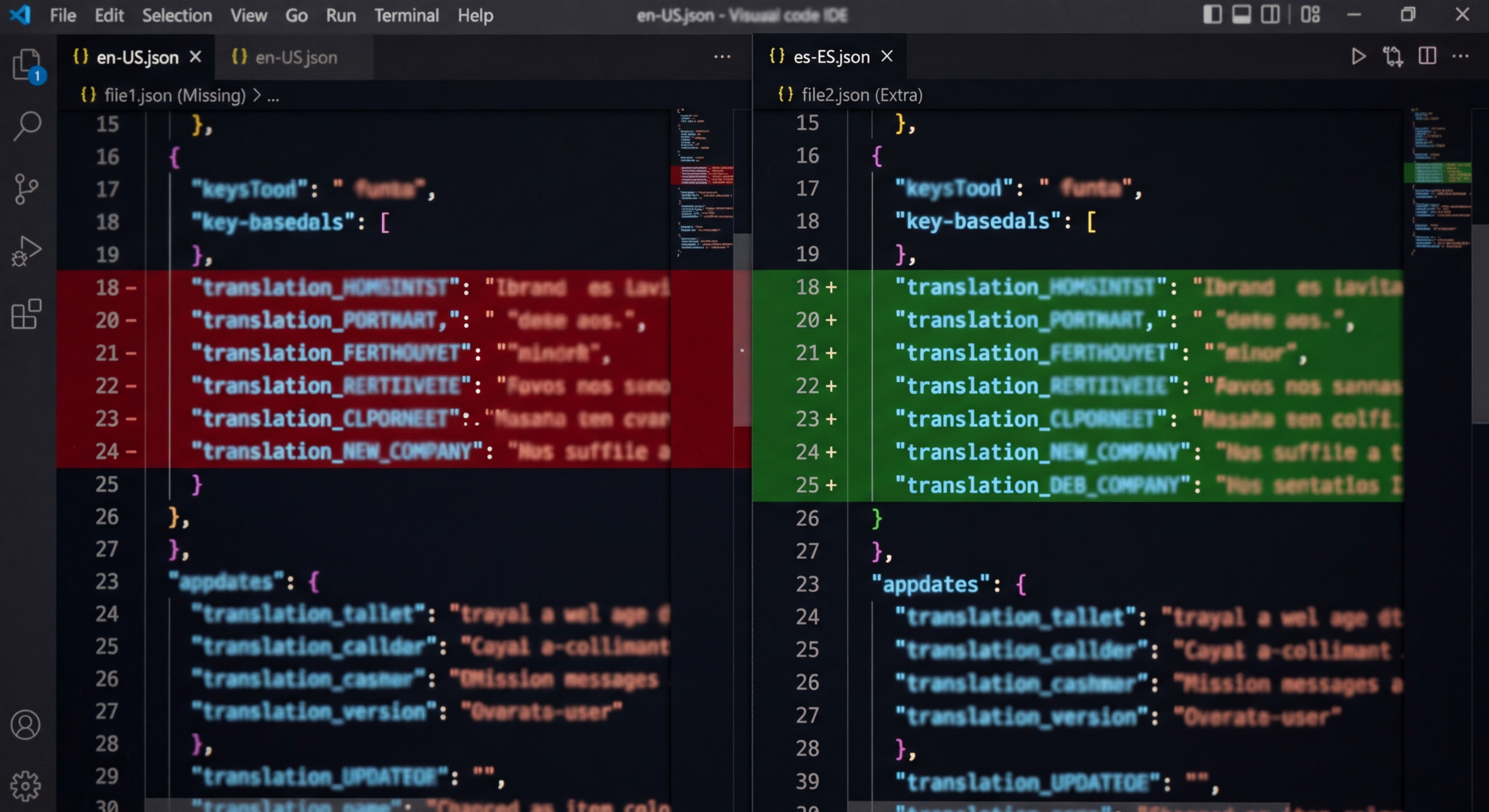
Penyegerakan Fail Terjemahan: Pastikan Kekunci i18n Disegerakkan Merentas Semua Lokal
Setiap kali pembangun menambahkan kekunci pada lokal sumber, 15 fail lokal lain menjadi tidak segerak. Kekunci yang tiada memaparkan laluan mentah kepada pengguna. Kekunci lapuk membazirkan masa penterjemah dan saiz bundle. Penyegerakan automatik memastikan semuanya kekal selaras.
Masalah Penyegerakan
Fail terjemahan sentiasa menyimpang. Pembangun menambahkan 'settings.notifications.title' pada en.json, tetapi terlupa menambahkannya pada 15 fail lokal lain. Pembangun lain membuang 'onboarding.welcome' daripada kod, tetapi membiarkannya dalam semua fail lokal. Pembangun ketiga menamakan semula 'user.name' menjadi 'user.displayName' dalam bahasa Inggeris, tetapi tidak dalam lokal lain. Selepas berbulan-bulan, fail lokal anda menyimpang: terdapat kekunci yang tiada, lapuk, atau tidak sepadan antara lokal.
// The problem: translation files drift out of sync

// Developer adds a new feature with new keys:
// en.json (source of truth)
{
  "nav.home": "Home",
  "nav.about": "About",
  "nav.pricing": "Pricing",     // NEW
  "nav.changelog": "Changelog"  // NEW
}

// de.json (out of sync - missing new keys)
{
  "nav.home": "Startseite",
  "nav.about": "Über uns"
  // nav.pricing - MISSING
  // nav.changelog - MISSING
}

// de.json also has stale keys from deleted features:
{
  "nav.home": "Startseite",
  "nav.about": "Über uns",
  "nav.legacy_page": "Alte Seite"  // STALE - removed from en.json
}Mengesan Kekunci yang Tiada
Kekunci yang tiada ialah kekunci yang wujud dalam lokal sumber, tetapi tiada dalam lokal sasaran. Ini ialah masalah penyegerakan paling lazim dan paling merosakkan — pengguna melihat laluan kekunci mentah seperti 'settings.notifications.title' dan bukannya teks terjemahan. i18n-validate mengesan kekunci yang tiada dengan membandingkan struktur kekunci setiap lokal terhadap sumber.
# Detect missing and stale keys
npx i18n-validate sync \
  --source locales/en.json \
  --targets 'locales/*.json'

# Output:
# locales/de.json:
#   Missing keys (2):
#     - nav.pricing
#     - nav.changelog
#   Stale keys (1):
#     - nav.legacy_page
#   Coverage: 66.7% (2/3 keys)
#
# locales/ja.json:
#   Missing keys (5):
#     - nav.pricing
#     - nav.changelog
#     - settings.theme
#     - settings.language
#     - settings.notifications
# Coverage: 50.0% (5/10 keys)Mengesan Kekunci Lapuk
Kekunci lapuk ialah kekunci yang wujud dalam fail terjemahan, tetapi tidak lagi dirujuk dalam kod. Kekunci lapuk membazirkan masa penterjemah (penterjemah menterjemahkan rentetan yang tidak dilihat oleh sesiapa), meningkatkan saiz bundle, dan mengelirukan penyelenggaraan. Mengesan kekunci lapuk memerlukan semakan silang antara fail lokal dan rujukan kod.
# Step 1: Check which files are out of sync
npx i18n-validate sync --source locales/en.json --targets 'locales/*.json'

# Step 2: Auto-fill missing keys with source values (as placeholders)
npx i18n-validate sync \
  --source locales/en.json \
  --targets 'locales/*.json' \
  --fill-missing \
  --fill-value "[NEEDS TRANSLATION] {{source}}"

# Step 3: Remove stale keys no longer in source
npx i18n-validate sync \
  --source locales/en.json \
  --targets 'locales/*.json' \
  --remove-stale

# Step 4: Sort keys to match source order (cleaner diffs)
npx i18n-validate sync \
  --source locales/en.json \
  --targets 'locales/*.json' \
  --sort-keys

# All at once:
npx i18n-validate sync \
  --source locales/en.json \
  --targets 'locales/*.json' \
  --fill-missing \
  --remove-stale \
--sort-keysMengautomatikkan Penyegerakan
Strategi penyegerakan paling berkesan menggabungkan tiga lapisan: 1) Cangkuk pre-commit yang mengesahkan penyegerakan pada setiap komit. 2) Pemeriksaan saluran CI yang menyekat penggabungan bermasalah. 3) Audit penuh berkala yang mengesan penyimpangan terkumpul daripada hotfix dan penyuntingan manual.
# .husky/pre-commit
#!/bin/sh
. "$(dirname "$0")/_/husky.sh"

# Check if source locale file changed
SOURCE_CHANGED=$(git diff --cached --name-only | grep -c 'locales/en.json')

if [ "$SOURCE_CHANGED" -gt 0 ]; then
  echo "Source locale changed - checking sync..."

  npx i18n-validate sync \
    --source locales/en.json \
    --targets 'locales/*.json' \
    --fail-on-missing \
    --min-coverage 90

  if [ $? -ne 0 ]; then
    echo ""
    echo "Translation files are out of sync!"
    echo "Run: npx i18n-validate sync --fill-missing"
    exit 1
  fi
fi# .github/workflows/i18n-sync.yml
name: Translation Sync Check
on:
pull_request:
paths:
- 'locales/**'
jobs:
sync-check:
runs-on: ubuntu-latest
steps:
- uses: actions/checkout@v4
- name: Check translation sync
run: npx i18n-validate sync \
--source locales/en.json \
--targets 'locales/*.json' \
--fail-on-missing \
--min-coverage 95
- name: Comment on PR if out of sync
if: failure()
uses: actions/github-script@v7
with:
script: |
github.rest.issues.createComment({
issue_number: context.issue.number,
owner: context.repo.owner,
repo: context.repo.repo,
body: 'Translation files are out of sync. Please run npx i18n-validate sync --fill-missing and commit.'
})Pelaporan Liputan Terjemahan
Liputan terjemahan ialah peratusan kekunci sumber yang mempunyai terjemahan dalam setiap lokal sasaran. i18n-validate menjana laporan liputan yang menunjukkan peratusan bagi setiap lokal dan menyoroti lokal yang ketinggalan. Gunakan ambang liputan dalam CI untuk menyekat penggabungan apabila liputan turun di bawah tahap yang boleh diterima.
// Split large translation files by feature/namespace
// locales/
// ├── en/
// │   ├── common.json      (nav, footer, errors)
// │   ├── auth.json         (login, register, reset)
// │   ├── dashboard.json    (dashboard-specific)
// │   └── settings.json     (settings page)
// ├── de/
// │   ├── common.json
// │   ├── auth.json
// │   ├── dashboard.json
// │   └── settings.json

// Sync with namespace support:
npx i18n-validate sync \
  --source 'locales/en/*.json' \
  --targets 'locales/*/%.json' \
  --namespace-pattern '{locale}/{namespace}.json'

// Benefits:
// - Smaller files, easier to review
// - Feature teams own their translations
// - Lazy-load only needed namespaces
// - Parallel translation workflowsCuba i18n Agent Sekarang
Lepaskan fail terjemahan anda di sini
JSON, YAML, PO, XML, CSV, Markdown, Properties
atau klik untuk semak imbas
Bahasa sasaran