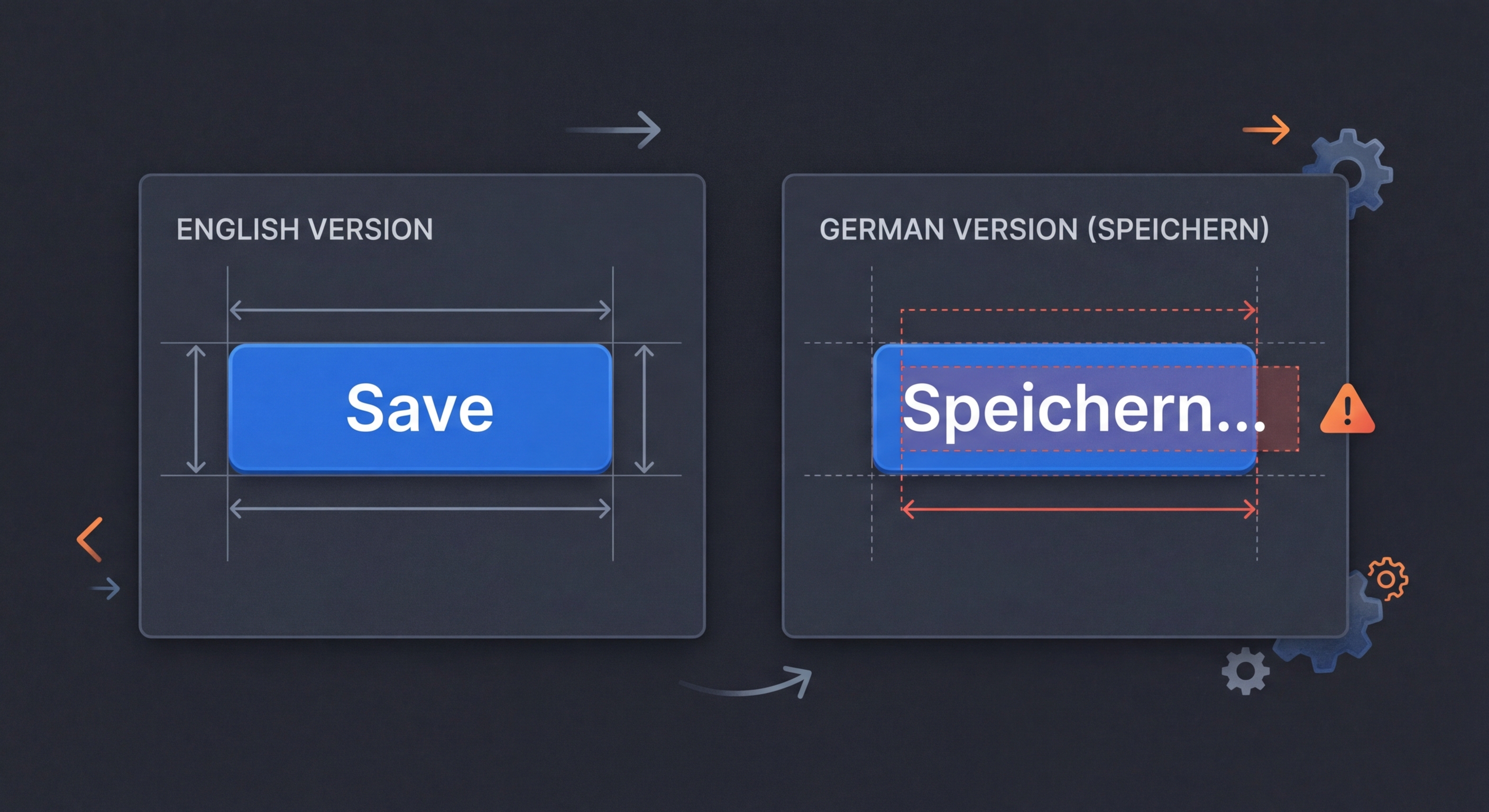
Espansione del testo nell'i18n: evitare problemi di layout causati dalla lunghezza delle traduzioni
L'interfaccia inglese si adatta perfettamente. Poi arrivano le traduzioni tedesche, più lunghe del 30%, e quelle finlandesi, più lunghe del 40%. I pulsanti fuoriescono, le tabelle non funzionano più e il layout progettato con cura si deforma. I test di espansione del testo evitano questi problemi.
Perché l'espansione del testo compromette i layout
Gli sviluppatori progettano le interfacce con testo inglese, una delle lingue più compatte. Quando arrivano le traduzioni, le lingue più lunghe fuoriescono dai contenitori, compromettono i layout a griglia, troncano le etichette dei pulsanti e spingono i contenuti fuori dallo schermo. Questi errori appaiono soltanto in lingue specifiche e rimangono quindi invisibili durante lo sviluppo e i test esclusivamente in inglese.
// English is one of the most compact languages.
// Translations are almost always LONGER.

// English (source):
"Save"           // 4 chars

// Translations:
"Speichern"      // German: 10 chars (+150%)
"Enregistrer"    // French: 12 chars (+200%)
"Guardar"        // Spanish: 7 chars (+75%)
"Сохранить"      // Russian: 9 chars (+125%)
"Tallenna"       // Finnish: 8 chars (+100%)

// Buttons, labels, and table headers designed for
// English text WILL break in other languages.Rapporti di espansione del testo per lingua
Rapporti medi di espansione rispetto al testo di origine inglese. Le stringhe brevi, con meno di 20 caratteri, si espandono più di quelle lunghe, perché la scelta delle singole parole influisce maggiormente sulla lunghezza totale.
// Average text expansion relative to English:

// European languages:
// German:     +30-35%  (compound words)
// Finnish:    +30-40%  (agglutinative)
// French:     +15-25%  (articles, prepositions)
// Spanish:    +15-25%
// Italian:    +15-25%
// Portuguese: +15-25%
// Russian:    +20-30%  (case endings)
// Polish:     +20-30%
// Greek:      +20-30%

// Asian languages (CJK):
// Chinese:    -30-50%  (shorter in characters, but wider per char)
// Japanese:   -20-40%  (kanji compress meaning)
// Korean:     -10-20%

// Right-to-left:
// Arabic:     +20-30%
// Hebrew:     +10-20%

// Rule of thumb by source string length:
// 1-10 chars:   expect +200% expansion
// 11-20 chars:  expect +80% expansion
// 21-70 chars:  expect +40% expansion
// 71+ chars: expect +30% expansionTest con i18n-pseudo
La strategia di espansione di i18n-pseudo aggiunge riempimento alle stringhe di origine per simulare la lunghezza delle traduzioni. Imposti il rapporto in base alle lingue di destinazione e testi i layout prima che arrivino le traduzioni reali.
# Method 1: Pseudo-localization with expansion
npx i18n-pseudo generate \
  --source locales/en.json \
  --output locales/pseudo-expanded.json \
  --expansion 1.4 \
  --preset expanded

# Method 2: Longest-translation analysis
npx i18n-validate expansion \
  --source locales/en.json \
  --targets 'locales/*.json' \
  --report expansion-report.json

# Output:
# Key                  | EN  | Longest | Lang | Ratio
# ---------------------|-----|---------|------|-------
# nav.settings         | 8   | 14      | de   | 175%
# buttons.save         | 4   | 12      | fr   | 300%
# errors.networkFailed | 14  | 28      | fi   | 200%

# Method 3: Visual regression with expanded text
npx playwright test \
  --project=expansion-test \
--update-snapshots// playwright.config.ts
export default defineConfig({
projects: [
{
name: 'expansion-test',
use: {
locale: 'pseudo-expanded',
},
},
],
});
// tests/expansion.spec.ts
test('buttons do not overflow with expanded text', async ({ page }) => {
await page.goto('/');
// Check no horizontal overflow
const buttons = await page.locator('button').all();
for (const button of buttons) {
const box = await button.boundingBox();
const parent = await button.locator('..').boundingBox();
expect(box!.x + box!.width).toBeLessThanOrEqual(
parent!.x + parent!.width
);
}
// Visual snapshot comparison
await expect(page).toHaveScreenshot('homepage-expanded.png', {
maxDiffPixels: 100,
});
});Procedure di design consigliate per l'i18n
Creare layout che gestiscano l'espansione del testo richiede decisioni di design prese prima di iniziare qualsiasi traduzione. Queste procedure evitano gli errori più comuni legati all'espansione.
/* 1. Use flexible containers, not fixed widths */
/* WRONG */
.button { width: 120px; }

/* RIGHT */
.button { min-width: 80px; padding: 8px 16px; }

/* 2. Allow text wrapping in labels */
/* WRONG */
.label { white-space: nowrap; overflow: hidden; }

/* RIGHT */
.label { overflow-wrap: break-word; }

/* 3. Use CSS Grid/Flexbox for adaptive layouts */
.nav {
  display: flex;
  flex-wrap: wrap;
  gap: 8px;
}

/* 4. Reserve space for the longest expected translation */
/* Use min-width based on ~1.4x English length */
.table-header {
  min-width: max-content;
  padding-right: 16px;
}

/* 5. Test with the longest language first */
/* German and Finnish are good stress-test languages */

/* 6. For CJK: account for wider characters */
/* CJK characters are typically 2x the width of Latin chars */
/* Even though text is shorter, it may be wider visually */Provi subito i18n Agent
Trascinare qui il file di traduzione
JSON, YAML, PO, XML, CSV, Markdown, Properties
oppure fare clic per selezionarlo
Lingue di destinazione